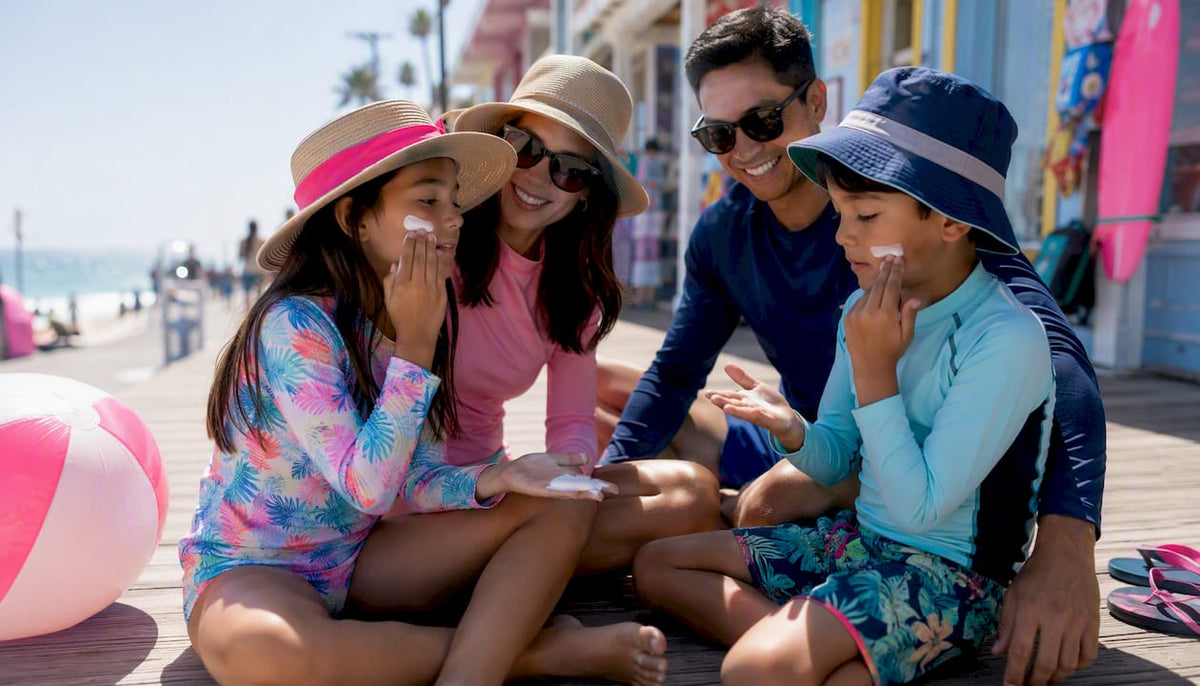
Yes, UPF swimwear is one of the most reliable sun-protection choices for kids and families. A UPF 50+ rating blocks approximately 98% of UV radiation on every covered area, every minute your child is in the water, with no reapplication required. The Skin Cancer Foundation awards its Seal of Recommendation only to garments that meet UPF 50+ testing standards, making that seal a fast, trustworthy filter when you shop. For parents, the practical advantage is straightforward: UPF swimwear removes the reapplication errors that make sunscreen less dependable on active, swimming kids. Dollhousebikinis carries swim pieces designed with coverage and style in mind, so protection does not have to mean sacrificing the look.
Table of Contents
- Why use UPF swimwear? UPF vs. SPF explained
- How do fabrics actually block UV radiation?
- What do UPF numbers actually mean?
- Why UPF swimwear matters most for children
- How to choose UPF swimwear for your child or family
- How to care for UPF swimwear and when to replace it
- Sunscreen vs. UPF clothing: how to layer protection effectively
- What dermatologists and research say about UPF swimwear
- Key Takeaways
- The case for making UPF part of every swim day
- Sun-smart swimwear at Dollhousebikinis
Why use UPF swimwear? UPF vs. SPF explained
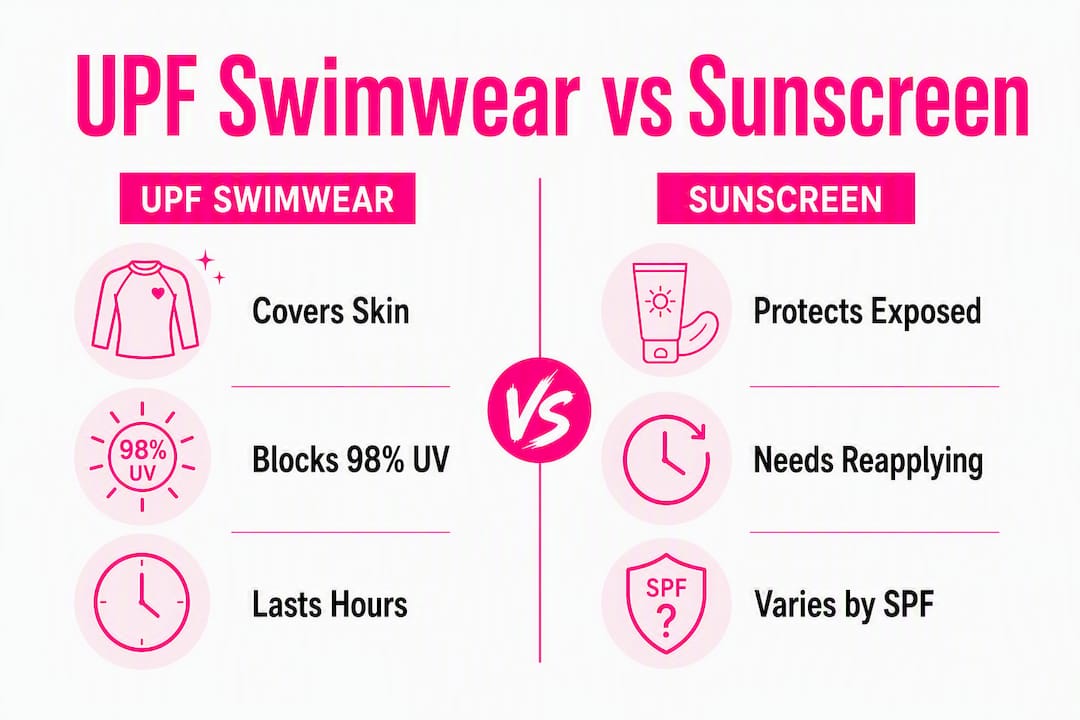
UPF stands for Ultraviolet Protection Factor. It measures how much UVA and UVB radiation a fabric transmits to the skin beneath it. SPF, by contrast, measures only how long a sunscreen delays UVB-induced redness on bare skin. That is a meaningful difference.
UPF (fabric):
- Covers both UVA and UVB (broad-spectrum)
- Protection is continuous while the garment is worn
- No reapplication needed for covered skin
- Performance depends on weave, fiber, fit, and wetness
SPF (sunscreen):
- Primarily measures UVB protection
- Degrades with sweat, water, and time
- Must be reapplied every 40–80 minutes during water activity
- Covers exposed skin only
For parents, the split is practical: UPF swimwear handles the covered zones automatically, while sunscreen handles the face, hands, and feet. Neither replaces the other. Together, they cover the whole body.
How do fabrics actually block UV radiation?
Two types of protection exist in UPF garments: structural and applied.
Structural protection comes from the fabric itself. Tight weaves and knits leave fewer microscopic gaps between yarns, so less UV passes through. Fiber chemistry matters too. Synthetic fibers like polyester and nylon block UV more reliably than natural fibers like cotton, especially when wet. A white cotton T-shirt can carry a UPF as low as 7 when dry and drop to around UPF 3 when wet. A purpose-built UPF swimsuit using polyester or nylon holds its rating in the water.
Applied protection uses UV-absorbing dyes or chemical finishes added during manufacturing. These can boost a fabric’s rating but may degrade faster than structural protection over repeated washes.
Fit also affects performance. Stretching opens gaps in the weave, reducing UPF. A swimsuit pulled tight across the shoulders or back lets more UV through than one with a relaxed fit. For kids who are constantly moving, this matters.
Features to look for:
- Tight knit or woven construction
- Polyester or nylon blend (quick-dry synthetics)
- Dense, dark, or UV-absorbing dye
- Minimal stretch under normal wear
- Reinforced seams that resist distortion
Pro Tip: Size up slightly for kids. A little extra room in the fit preserves the weave structure and keeps UPF performance closer to what the label states.
What do UPF numbers actually mean?
| UPF Rating | Category | UV Blocked |
|---|---|---|
| 15–20 | Good | ~93% |
| 25–35 | Very Good | ~96–97% |
| 40–50+ | Excellent | ~98% |
The Skin Cancer Foundation recommends UPF 50+ as the benchmark for sun-protective clothing. At that rating, less than 2% of UV radiation reaches the skin. Manufacturers label garments “UPF 50+” rather than a specific number because laboratory spectrophotometers measure transmission below 2% and the scale effectively maxes out there.
The Skin Cancer Foundation’s Seal of Recommendation is tested on the lightest color in a product line and requires lifecycle simulation, not just new-fabric performance. That means the seal reflects how the garment performs after real-world wear and washing, not just out of the box.
UPF testing uses ASTM D 6544 and AATCC methods to simulate washing, abrasion, and UV exposure over time. A garment that holds UPF 50+ through those tests is genuinely protective across a season of use, not just on day one.
Why UPF swimwear matters most for children
Children’s skin is thinner and more UV-sensitive than adult skin, and kids accumulate a significant share of their lifetime UV exposure during childhood. Sunburns in early life are directly linked to higher skin cancer risk later. Getting consistent, reliable coverage on a moving, splashing child is where UPF swimwear has a clear advantage over sunscreen alone.
Dermatologists recommend UPF-rated apparel as the “first line of defense” because it removes human reapplication errors and protects areas like the back that kids and caregivers often miss with sunscreen.
UPF clothing reduces the everyday friction of sun safety. No reapplication, consistent coverage, and it stays in place even when kids are swimming, running, and toweling off. For active children, that consistency is the real protection advantage.
UPF 50+ blocks approximately 98% of UV radiation on every covered area, continuously. That figure does not change because a child jumped in the pool or forgot to stand still while you applied lotion.
One limit to keep in mind: UPF swimwear covers the torso, arms, and legs. The face, hands, and feet remain exposed and still need sunscreen. Coverage-forward styles like swim shirts and long-sleeve rashguards extend protection to the shoulders and upper arms, which are among the highest-burn zones for kids.
How to choose UPF swimwear for your child or family
Start with the rating. UPF 50+ is the target. If a garment carries the Skin Cancer Foundation Seal of Recommendation, the testing standard is already met.
Buying checklist:
- UPF 50+ label or Skin Cancer Foundation Seal
- Polyester or nylon blend fabric (quick-dry)
- Slightly relaxed fit, not stretched tight across the body
- Long sleeves or higher neckline for shoulder and back coverage
- Minimal transparency when held up to light
- Secure seams that do not gap or distort under movement
- Size range with adjustability for growing kids
Prioritize one or two pieces that cover the large burn zones — a long-sleeve rashguard or swim shirt — rather than trying to make every item UPF-rated. That approach gives the most protection per dollar.
For fabric trade-offs, high-quality UPF clothing uses synthetic fiber blends for breathability alongside UV protection. A garment that is too hot to wear consistently defeats the purpose. Quick-dry polyester blends tend to balance both.

The light-transparency test is a fast field check: hold the fabric up to a bright light source. If you can see your hand clearly through it, the weave is too open for reliable UV protection.
Pro Tip: Mix and match coverage. A UPF swim shirt paired with a standard bikini bottom gives full upper-body protection without requiring a full UPF suit. Check the features of quality swimwear to know what construction details actually hold up.
For fit guidance across sizes, the plus size swimwear fit guide covers how to balance coverage and comfort across different body types.
How to care for UPF swimwear and when to replace it
UPF performance degrades with wear. Knowing what damages it helps you extend the life of each piece.
Main durability threats:
- Chlorine exposure (breaks down synthetic fibers over time)
- UV degradation from extended sun exposure while not in the water
- Stretching from a too-tight fit
- Abrasion from pool edges, sand, and rough surfaces
- Hot dryer cycles and bleach
Care do’s and don’ts:
Do:
- Rinse in cold water immediately after pool or ocean use
- Hand wash or use a gentle machine cycle with mild detergent
- Dry flat in shade or indoors
- Rotate between two or three pieces to reduce wear per item
Don’t:
- Use bleach or fabric softener (both degrade UV-absorbing finishes)
- Wring or twist the fabric
- Leave wet swimwear in a bag for hours before rinsing
- Machine dry on high heat
Replace a piece when you see visible thinning, increased transparency, pilling, or seams that no longer hold their shape. There is no fixed wash count that applies universally. Fabric condition is the reliable indicator. For kids’ gear specifically, storing pieces out of direct sun when not in use slows UV degradation between outings.
Sunscreen vs. UPF clothing: how to layer protection effectively
UPF swimwear and sunscreen are not competing options. They cover different zones and solve different problems.
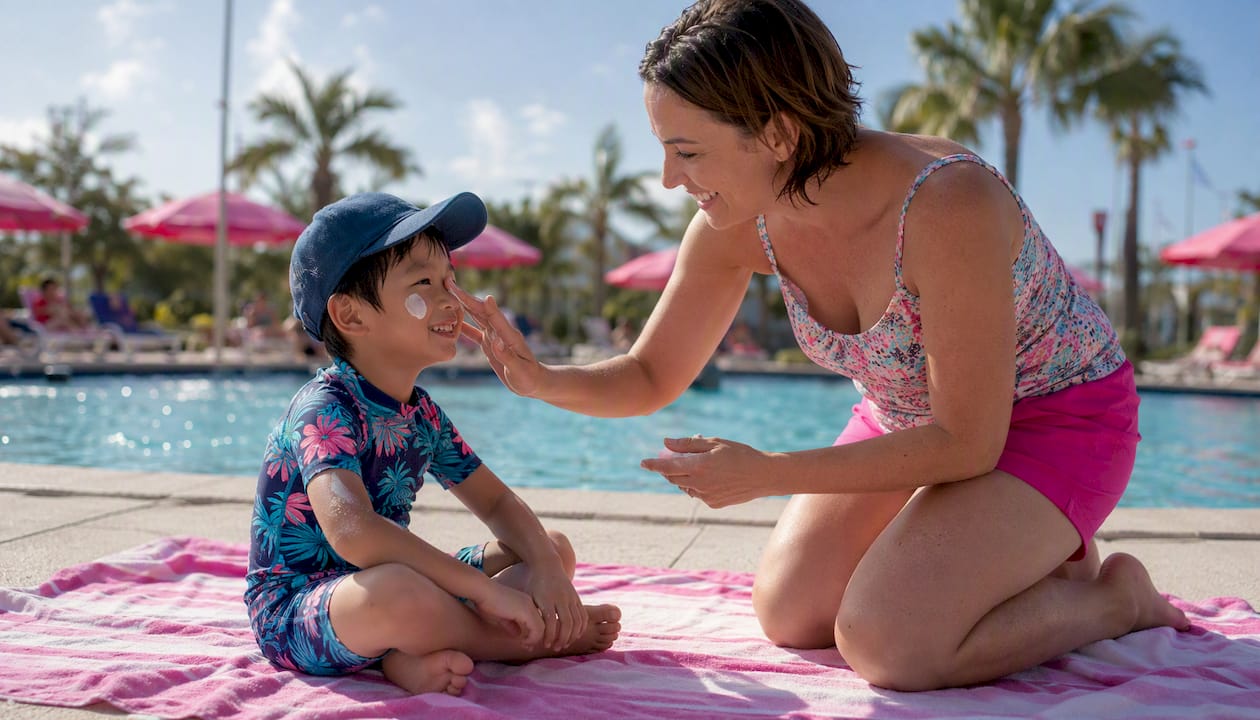
The core rule: UPF swimwear handles covered skin; broad-spectrum, water-resistant sunscreen handles everything exposed. Dedicated UPF swimwear maintains higher protection when wet, while standard sunscreen degrades with water and sweat and requires reapplication. Using both removes the gaps each one leaves on its own.
Layered protection routine for pool and beach days:
- Dress in a UPF 50+ swim piece that covers the back, shoulders, and arms
- Apply broad-spectrum SPF 30+ sunscreen to all exposed skin (face, neck, hands, feet)
- Apply sunscreen 15–30 minutes before going outside so it bonds to skin
- Reapply sunscreen every 40–80 minutes, or immediately after toweling off
- Seek shade during peak UV hours (10 AM to 4 PM)
- Add a wide-brim hat and UV-blocking sunglasses for face and eye protection
The combination matters most for kids who swim frequently. Every time a child towels off, sunscreen on exposed skin is partially removed. UPF-covered areas stay protected through that cycle without any action from you.
Pro Tip: Keep a travel-size sunscreen in your pool bag and set a phone timer for reapplication. Kids rarely remind you, and the 40-minute window passes faster than it sounds.
What dermatologists and research say about UPF swimwear
The evidence behind UPF swimwear is consistent across dermatology and public health sources.
UPF 50+ fabrics block approximately 98% of UV radiation in tested conditions, with ratings derived from laboratory spectrophotometer measurements combined with lifecycle simulations under AATCC 183 and ASTM D 6544 standards. Those tests simulate washing, abrasion, and UV exposure, so a labeled rating reflects real-world performance, not just new-fabric results.
Synthetic, tightly woven fabrics perform best. Wetness and stretch both reduce UPF, which is why quick-dry synthetics and a slightly relaxed fit are the practical recommendations for swimwear specifically.
Dermatologists consistently identify UPF clothing as the most reliable first line of defense for children because it provides continuous, consistent coverage without depending on correct application technique. Sunscreen remains necessary for exposed areas, but UPF garments remove the single biggest failure point in sun protection for active kids: human error.
The Cleveland Clinic confirms that synthetic fibers like polyester and nylon outperform natural fibers for UV protection, particularly when wet. Standard cotton, which many parents assume provides some protection, can drop to UPF 3 when wet. That is effectively no protection for a child in a pool.
The Skin Cancer Foundation’s Seal of Recommendation requires testing on the lightest color in a product line and lifecycle simulation, making it the most practical third-party trust mark for consumers shopping without access to lab data.
Key Takeaways
UPF 50+ swimwear blocks a high percentage of UV radiation on covered skin, making it a reliable sun-protection layer for active children and families who cannot depend on consistent sunscreen reapplication.
| Point | Details |
|---|---|
| UPF 50+ is the target rating | Blocks ~98% of UV; look for the Skin Cancer Foundation Seal as a fast verification. |
| Fabric and fit both affect performance | Choose quick-dry polyester or nylon blends; size slightly loose to prevent stretch-related protection loss. |
| Layer UPF clothing with sunscreen | UPF covers the torso and arms; apply broad-spectrum SPF 30+ to face, hands, and feet and reapply every 40–80 minutes. |
| Replace when fabric shows wear | Visible thinning, transparency, or distorted seams signal that protection has degraded, regardless of wash count. |
| Dollhousebikinis for coverage-forward styles | Browse swim shirts, coverups, and sets that pair protection with fashion for beach and pool days. |
The case for making UPF part of every swim day
Most sun-safety conversations focus on sunscreen, and sunscreen is necessary. But the research makes a clear case that UPF clothing is the more reliable layer for covered skin, particularly for kids. It does not wash off, does not require a cooperative child to stand still, and does not degrade in the first 20 minutes of pool time.
The part that often gets overlooked: the benefit is cumulative. A single beach day with good UPF coverage is not the point. The point is reducing total UV dose across hundreds of swim days over a childhood. That is where the skin cancer risk reduction actually comes from, and it is why dermatologists frame UPF clothing as a first line of defense rather than a backup option.
Style matters too, practically speaking. A child who refuses to wear a rashguard because it is uncomfortable or unfashionable gets no protection from it. Choosing pieces that fit well, move well, and look good is not a vanity consideration. It is a compliance consideration. The best UPF garment is the one that actually gets worn.
Sun-smart swimwear at Dollhousebikinis
Dollhousebikinis carries swim pieces built for real beach and pool days, including coverups, swim sets, and styles with extended coverage that pair naturally with a sun-safety routine.
For parents looking to add a coverage layer without giving up style, the swimwear beach coverup is a practical pick: it adds full-body coverage between swims and doubles as a stylish wrap off the water. The two-piece swimsuit with jumpsuit coverup bundles a swim set with a coverup in one purchase, which simplifies the layered-protection approach the research recommends. Browse the full catalog at Dollhousebikinis to find swim styles that work with your sun-safety routine, not against it.