
Shopping for swimwear online gets a bad reputation it doesn’t fully deserve. The fit anxiety is real, sizing charts can feel unreliable, and nobody wants to deal with a clunky return. But the truth is, once you understand why shop swimwear online works in your favor, the entire process becomes faster, cheaper, and far more style-forward than anything your local mall can offer. This guide covers the real benefits, the practical tools, and the money-saving tactics that make online swimwear shopping the smarter choice for women and young adults who want great style without the guesswork.
Table of Contents
- Key takeaways
- Why shop swimwear online: the real advantages
- How to solve the fit problem online
- Evaluating swimwear quality from a product page
- Smart tactics for pricing, returns, and hidden costs
- Staying current on trends when buying online
- My take on the “try before you buy” myth
- Shop swimwear at Dollhousebikinis
- FAQ
Key takeaways
| Point | Details |
|---|---|
| Wider selection online | Online stores carry sizes 4 to 44 and thousands of styles unavailable in most physical stores. |
| Fit tools reduce returns | AI sizing tools and detailed size charts can cut fit-related returns by up to 50%. |
| Hidden return costs exist | Restocking fees of $8 or more and tight return windows make sizing accuracy critical before you buy. |
| Reviews are your fitting room | Customer photos and peer reviews are your most reliable tool for judging real-world fit and quality. |
| Quality markers are readable | Fabric type, seam construction, and UV protection details on product pages tell you what a suit is actually worth. |
Why shop swimwear online: the real advantages
The convenience of online swimwear shopping goes well beyond skipping a parking lot. You can browse at midnight, compare five different bikini styles in two minutes, and find a size that no local boutique stocks. That’s not a small thing.
Here’s what you actually get when you shop swimwear from home:
- 24/7 access. No store hours, no weekends-only sales rack. Your shopping window is always open.
- Massive selection. Online retailers feature thousands of styles across a size range most brick-and-mortar stores never touch.
- Better pricing. Direct-to-consumer online brands carry less overhead than physical retailers, which often means lower prices and more frequent promotions.
- Easy trend comparison. Lookbooks, new arrival filters, and “most popular” sorting let you track what’s trending in real time.
- Privacy. Trying on swimwear in a public fitting room under fluorescent lighting is nobody’s favorite experience. Shopping at home removes that friction entirely.
The online vs in-store swimwear buying conversation used to favor physical stores because of fit. That argument is weakening fast. The tools available now, from AI sizing quizzes to customer-submitted photos, do a lot of the work a fitting room used to do. And when you know how to use them, the benefits of online swimwear shopping become very hard to ignore.
How to solve the fit problem online
Fit is the top reason people hesitate to buy swimwear online, and it’s the top reason for returns. Swimwear return rates hit 40 to 50%, which is significantly higher than the 19.3% average for general apparel e-commerce. That number isn’t a reason to avoid online shopping. It’s a reason to shop smarter.
Pro Tip: Before ordering, take three measurements: bust, waist, and hips. Then cross-reference them against the brand’s specific size chart, not a generic one. Brands cut differently, and a medium at one label can be a large at another.
Here’s a practical approach to getting fit right the first time:
- Use the brand’s own size chart. Generic sizing means nothing. Focus on the measurements the specific brand provides.
- Look for model measurements. Product pages that list the model’s height and the size she’s wearing give you a direct comparison point.
- Check fabric stretch details. A suit made from 4-way stretch fabric will accommodate a wider fit range than a structured style with minimal give.
- Read the fit notes. Good product pages include notes like “runs small in the bust” or “true to size.” That’s the information you actually need.
- Use AI sizing tools when available. AI-powered sizing tools reduce returns by 20 to 50% and can increase purchase confidence significantly.
- Read customer reviews for fit accuracy. Consumer reviews and user-submitted photos are your most reliable source for real-world fit data. Look for reviewers with similar measurements to yours.
Treating how to shop swimsuits online as a data process rather than a gamble is the shift that changes everything. You’re not guessing. You’re comparing information.
Evaluating swimwear quality from a product page
Knowing how to read a product page for quality is a skill that separates confident online shoppers from frustrated returners. Fabric and construction details are right there if you know what to look for.

Fabrics that actually last
| Fabric | Best for | Watch out for |
|---|---|---|
| Polyester/Lycra blend | Everyday beach use, color retention | Lower stretch recovery in cheap versions |
| Nylon/spandex | Soft feel, good stretch | Less chlorine-resistant than polyester |
| Chlorine-resistant polyester | Lap swimming, frequent pool use | Can feel stiffer than nylon blends |
| Recycled polyester | Eco-conscious buyers | Quality varies by brand |
Fabric composition is listed in every product description. A polyester/Lycra blend in the 80/20 to 85/15 range is a reliable standard for durability and shape retention. Anything below that Lycra percentage tends to lose elasticity faster.
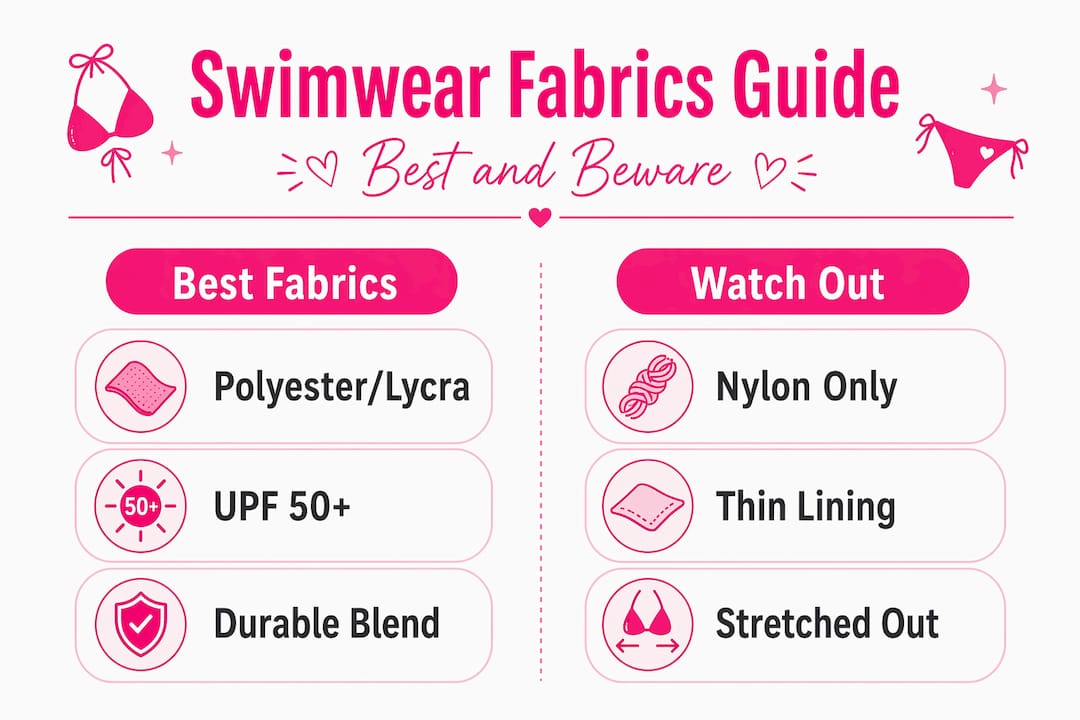
Pro Tip: Look for swimwear that lists UV protection (UPF 50+) in the product details. It’s a quality indicator as much as a sun safety feature, and it typically signals better fabric construction overall. The features of quality swimwear include seam type, lining, and UV rating.
Professional swimwear testing covers over 40 hours per suit, collecting more than 700 data points across different body types. What that tells you as a shopper: construction quality shows up quickly under real use. Look for double-stitched seams, a full inner lining on the seat, and adjustable hardware that won’t corrode. Those are the details that separate a $40 suit that lasts two seasons from one that pills and fades after three beach trips.
Smart tactics for pricing, returns, and hidden costs
The financial side of online swimwear shopping has more nuance than most buyers expect. Knowing the rules before you order saves you real money.
Where the deals actually are
Online retailers price swimwear differently based on their model. Direct-to-consumer brands cut out the wholesale markup, which can mean 20 to 40% lower prices compared to department store equivalents. End-of-season sales hit harder online too, with clearance filters that show you exactly what’s discounted without digging through a rack.
To save money on swimwear online, bundle your order. Many online stores, including Dollhousebikinis, offer free shipping above a threshold (often around $100). Ordering a top, bottom, and a cover-up together to hit that threshold costs you less than paying shipping on each piece separately.
What to check before you click buy
- Return window. Know exactly how many days you have. Many retailers operate on 21 to 30-day windows, and that clock starts at purchase, not delivery.
- Hygiene liner rules. Most retailers require the hygiene liner to be intact for any return. Remove it and your return option disappears.
- Who pays return shipping. Some retailers cover it. Others deduct from your refund or charge a flat fee.
- Restocking fees. Restocking fees can reach $8 or more per return, turning a sizing mistake into a real cost. That’s why accuracy upfront matters.
A clear and fair return policy is the single most important factor for reducing uncertainty when buying swimwear online. Prioritize retailers that are transparent about every part of the process.
If a suit doesn’t work but a return feels too expensive, reselling through secondhand platforms is a legitimate option. A well-maintained suit in a popular style can recover most of its purchase price. It’s not the ideal scenario, but it beats eating the cost.
Staying current on trends when buying online
One underrated benefit of shopping for swimwear online is how easy it is to track what’s actually trending. Physical stores stock based on regional buying decisions made months in advance. Online retailers update inventory in real time and actively curate collections around current demand.
Right now, styles popular with women and young adults include:
- High-waisted bikini bottoms. A consistent bestseller that spans body types and comfort preferences.
- Cutout one-pieces. Structured with strategic cutouts for a fashion-forward look without going full bikini.
- Micro bikinis. Growing in popularity for poolside and resort wear.
- Sport-inspired swimwear. Racerbacks and athletic cuts crossing over from performance into everyday beach use.
- Floral and botanical prints. A perennial category with fresh color palettes each season.
Online retailers that work with influencers and publish lookbooks make trend-spotting even easier. You can see a style styled on a real person, read their review, and order in the same session. That kind of end-to-end discovery simply doesn’t exist in a physical store.
For those who want to understand trendy swimwear buying guides, Dollhousebikinis keeps an updated blog with styling notes and fit context that goes beyond a standard product page. It’s a useful resource when you’re deciding between styles.
Inclusive sizing has also expanded significantly online. Broad size ranges from 4 to 44 are now standard on many online platforms, while physical stores frequently stock a narrower range. For anyone who has struggled to find their size locally, the difference is substantial.
My take on the “try before you buy” myth
I’ve heard the argument that you should always try on swimwear in person before buying, and I think it’s mostly outdated advice. Here’s what I’ve actually learned from watching how shoppers use online tools well versus poorly.
In-store fitting room visits do not solve the fit problem. You’re still guessing whether a suit will hold up after six pool sessions, still making quick decisions under bad lighting, and still limited to whatever three styles your local store happened to order. The idea that physical is safer is a comfort bias, not a data-backed conclusion.
What I’ve found actually works is treating the product page like a specification sheet. When a retailer lists fabric content, model measurements, stretch rating, and customer photos, you have more useful information than a fitting room gives you. The shoppers who come back frustrated are almost always the ones who skipped the size chart or ignored the “runs small” note in the reviews.
The uncomfortable truth about returns is this: they cost you more than you expect. Between tight return windows, hygiene liner rules, and potential restocking fees, the “I’ll just return it” plan has a real price tag. That’s not a reason to avoid online shopping. It’s a reason to measure carefully and read everything before you buy.
— Ryan
Shop swimwear at Dollhousebikinis
Dollhousebikinis carries a full catalog of swimwear designed for women and young adults who want current styles, reliable fit information, and straightforward shopping. Product pages include fabric details, stretch ratings, and sizing notes so you have what you need to buy with confidence.
The catalog covers bikini sets, monokinis, high-waisted styles, micro bikinis, and beach cover-ups for a complete look. For shoppers who want a proven style with full fit documentation, the original swimsuit collection is a strong starting point. Orders over $100 ship free, making it easy to bundle styles and save. New arrivals and promotions are updated regularly, so checking back between seasons is worth your time.
FAQ
Why is it better to shop swimwear online than in stores?
Online swimwear shopping gives you access to far more styles, inclusive sizing, and better pricing than most physical stores carry. You can compare fit details, read customer reviews, and shop on your own schedule without geographic limits.
How do I get the right fit when buying swimwear online?
Take your bust, waist, and hip measurements and compare them directly against the brand’s size chart. Look for product pages that list model measurements, fabric stretch ratings, and fit notes. Shoppers who treat sizing as a data process have significantly better results.
What fabric should I look for in quality swimwear?
A polyester/Lycra blend in the 80 to 85% polyester range is a solid standard for durability, color retention, and shape retention. Look for swimwear fabric details that include UPF protection and 4-way stretch as quality indicators.
Are there hidden costs to returning swimwear online?
Yes. Return shipping, hygiene liner requirements, and restocking fees that can reach $8 or more per order add up fast. Read the return policy in full before purchasing, and prioritize retailers with transparent, buyer-friendly terms.
What swimwear styles are trending right now?
High-waisted bikini bottoms, cutout one-pieces, floral print sets, and sport-inspired swimwear are all strong in 2026. Online retailers update inventory faster than physical stores and often provide lookbooks and customer photos to show how styles actually fit.