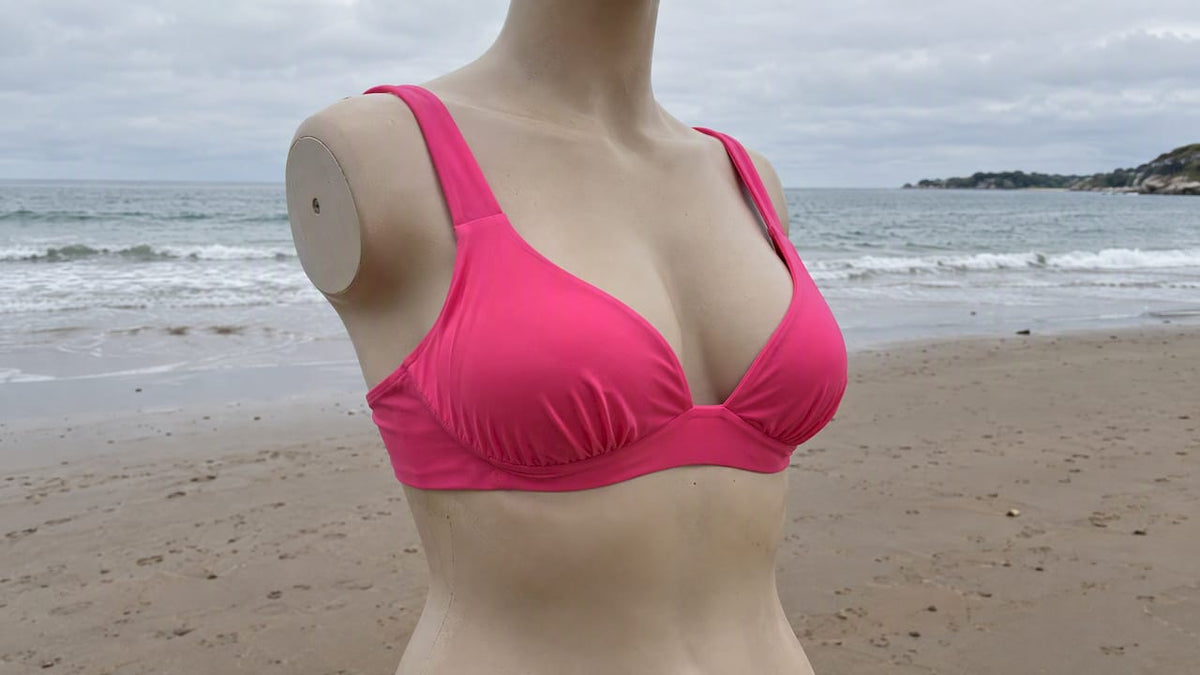
A bikini without underwire can be supportive. The support comes from construction: a firm underbust band, wide adjustable straps, structured or seamed cups, and secure closures. Styles with those features hold. Soft triangles and plain bandeaus usually do not.
This guide covers each part of a wire-free top, which styles hold best, how to test fit, and how to match a style to an activity.
TL;DR
- Support in a wireless bikini comes from the underbust band first, then straps, cup structure and closures.
- High-neck, halter, racerback, cross-back, longline and shelf-bra tops hold more than soft triangles or bandeaus.
- A loose band cannot be fixed by tightening the straps. Pain or digging signals a fit problem, not proper support.
- Test every top in motion: raise the arms, bend, turn sideways, and swim before cutting tags.
- Active swimming needs more security than lounging. Choose the style by activity.
Table of Contents
- Why Underwire Is Not the Only Source of Support
- The Four Parts of a Supportive Wireless Top
- Wire-Free Styles Compared by Support Level
- Matching the Style to the Activity
- How to Test Fit Before Cutting the Tags
- Fit Notes by Bust Size
- Our Perspective
- Wire-Free Styles at Doll House
- Quick Checklist for Choosing
- FAQ
- Sources
Why Underwire Is Not the Only Source of Support
Underwire is one way to lift and separate. It is not the only one. Expert-reviewed shopping coverage lists the wireless features that do the work: a substantial underbust band, wide adjustable straps, adjustable closures, and structured or seamed cups with enough coverage. The same coverage quotes a market director who describes a compressive wireless top as supportive without excess restriction when a wide band and broad strap work together.
That makes support a construction question. A top can have no wire and still hold well. A top can also have a wire and fit badly.
Some shoppers still prefer underwire for shape and lift. Those styles are covered in Why Choose Underwire Bikinis: Support, Shape, and Fit. The rest of this page covers wire-free options.
The Four Parts of a Supportive Wireless Top
1. Underbust band
The band is the foundation. It carries most of the weight when it sits snug and level around the ribcage. When the band is loose, weight moves to the shoulders. Tightening the straps then makes the problem worse, because the top rides up and the straps dig in.
What to check:
- The band sits flat, with no rolling or rising at the back.
- It is wide enough not to cut into skin.
- Elastic or a firm closure keeps it in place when wet.
2. Straps
Wide straps spread pressure across the shoulders. Narrow straps look light but concentrate load on a small area. Adjustable length matters because fabric stretches when wet and bodies vary in torso length. For tips on strap pain, see 3 Beach Ready Fixes to Stop Bikini Straps Digging In.
Strap layout also changes security:
- Halter: ties or clips behind the neck and shifts some load there. Adjustable ties allow fine tuning.
- Racerback or cross-back: straps pull toward the center of the back and resist sliding off the shoulders.
- Standard over-the-shoulder: comfortable for lounging, less secure in motion.
3. Cup structure and coverage
Cups hold shape through seams, lining or built-in padding. A cup with enough coverage contains breast tissue instead of relying on stretch alone. Seamed cups give shape without a wire. Plain single-layer fabric stretches and gives little structure.
Padding is not the same as support. Padding adds shape or modesty. Support comes from the band, straps and cup construction. For padded options, see Why Choose Structured Bikini Tops for Support and Style.
4. Closures
Adjustable closures let the band and neck be set to the body, not the other way around. Hook-and-eye backs, multiple hook rows, and tie backs with a secure knot all allow adjustment. A tie-back needs a double knot and a band that does not slip when wet.
Wire-Free Styles Compared by Support Level
Wire-free tops are not one support category. As a general rule, a soft triangle or bandeau gives less security than a high-neck, racerback, longline, shelf-bra or compression-style top with wide adjustable straps and a firm band. The table sorts common styles by that rule.
| Style | Support level | Best for | Watch for |
|---|---|---|---|
| Soft triangle, tie sides | Light | Lounging, smaller busts | Little structure, shifts with movement |
| Bandeau or strapless | Light | Sunbathing | Slips without grip; see the strapless fit guide |
| Halter with adjustable ties | Medium | Beach days, pool | Neck strain if the band is loose |
| Double-strap halter | Medium to firm | Beach days, light swimming | Check both straps adjust |
| Racerback or cross-back | Firm | Swimming, paddling, active play | Needs a snug band |
| High-neck or longline | Firm | Larger busts, active use | Coverage may feel warm in sun |
| Shelf-bra or compression top | Firm | Activity, fuller busts | Size carefully; too tight restricts |
| One-piece or monokini with built-in structure | Firm | Full coverage and security | Torso length must fit |
The style names here are generic. Specific features differ by product, so read each product page for strap, lining and closure details.
Matching the Style to the Activity
Activity changes the answer. Guidance from outdoor-gear experts points to higher-neck, racerback, cross-back or halter designs with secure straps, a built-in shelf bra or underbust elastic, and adequate side coverage for active swimming. Lounging allows lighter styles.
- Lounging by the pool: halter, soft cup or ruched styles work. Support demands are low.
- Beach walks and volleyball: a double-strap halter or racerback keeps the top in place during running and jumping.
- Lap swimming, paddling, diving: cross-back, racerback or one-piece construction. Elastic should be firm, and coverage should prevent shifting.
- Travel and all-day wear: adjustable straps and closures matter most, since the suit goes through heat, water and long hours.
How to Test Fit Before Cutting the Tags
A top that looks good standing still can fail in motion. Test it before committing. Expert guidance on large-bust swimwear recommends checking movement: raise the arms, bend, turn sideways. Spillage, a rising band, strap digging or gaps signal a fit problem.
A simple routine:
- Put the top on and set the band first, snug but not tight. Two fingers should slide under it.
- Adjust the straps so they hold without pulling the band upward.
- Raise both arms overhead. The band should stay level.
- Bend forward and twist side to side. Check for gaps at the cup edge.
- Jump a few times. Check for bounce, shifting and strap slide.
- Wear it for several minutes. Note any digging or pinching.
Pain is not proof of support. Testing and expert guidance find that a digging strap often means the band is too loose, and a suit that rides up or needs repeated tugging is the wrong size or construction. Fit should be snug but not constricting.
Bottoms need the same check. A rolling waistband or a wedgie in motion is a fit problem too. See Fit First: Stop Women’s Bikini Bottoms Rolling with Inner Grip and the 30 Second Movement Test to Prevent Swimsuit Wedgies.
Fit Notes by Bust Size
Fuller busts
Firm band, wide straps, structured cups and full coverage matter most. Styles to prioritize: high-neck, longline, racerback, cross-back and shelf-bra tops. Bra-style sizing (band plus cup) generally gives the most secure fit for larger cups, while S/M/L soft-cup sizing suits smaller cups, according to one swimwear sizing guide. Sizing in standard letter sizes means the band and cup are bundled, so a size up for the cup may loosen the band. Check the band after sizing up.

Smaller busts
Light styles hold well when the band is snug. Ruching, padding and cut-and-sew seams add shape. Options are covered in Best Bikinis for Small Bust.
Softer or lower-set breasts
Lift comes from structure under and at the sides of the cup, plus straps that hold the top at the right height. A wide band and seamed or lined cups help most. See Fit First Supportive Bikinis for Sagging Breasts That Lift.
Our Perspective
Most fit complaints we see trace back to the same issue: the band. A top that slides up, digs at the shoulders or spills at the sides usually has a band that is too loose or a strap layout that does not match the activity. Tightening the straps does not repair that.

We organize the catalog by product type, style and price so that a shopper can filter to the construction that suits the day: halter necks, high-waisted sets, one-pieces and monokinis, as well as lighter tops. Wire-free does not mean one level of support. A double-strap halter and a plain triangle sit at different points on that scale, and each has a place.
Our advice is simple. Pick the style for the activity first. Check the band second. Test in motion third. If a product page lacks the detail needed to judge strap width, lining or closure, treat that as a reason to compare with another style, not to guess.
— Ryan
Wire-Free Styles at Doll House
Shoppers comparing wire-free options can start with the Tops collection and the Bikini Sets collection, which include halter, ruched and high-waisted designs. Examples to review:
- Two Piece Double Straps Halter Neckline Bikini: a halter layout with double straps.
- High Waisted V-Neck Ruched Bikini Set: a high-waisted set with ruching.
- Sally High Waist Two Piece Swimsuit: a high-waist two-piece.
- Ava One Piece Swimsuit: a one-piece option for fuller coverage.
Filters on the site narrow results by product type, style, price range and popularity. Orders over $100 ship free, and an email signup brings a 10% discount. Sizing guides and detailed product descriptions are on each product page, so band, strap and coverage details can be compared before checkout.
Quick Checklist for Choosing
- Band: snug, flat, wide enough not to dig.
- Straps: wide, adjustable, with a layout matched to the activity.
- Cups: seamed, lined or padded, with enough coverage.
- Closures: adjustable, secure when wet.
- Fit: tested with arms raised, bending, turning and jumping.
- Size: if sizing up for the cup, recheck the band.
FAQ
Can a bikini top really be supportive without underwire?
Yes. Support comes from the underbust band, wide adjustable straps, structured cups and secure closures working together. Styles such as high-neck, racerback, longline and shelf-bra tops hold more than soft triangles or bandeaus. The fit of the band decides most of the result.
Which wire-free bikini style is best for swimming?
Racerback, cross-back, halter and high-neck tops with firm elastic and good side coverage are the usual choices for active swimming. Straps that pull toward the center of the back resist slipping. Test the top by raising the arms and bending before swimming in it.
Why do wireless bikini straps dig into shoulders?
Often the band is too loose, so the straps carry weight the band should carry. Narrow straps also concentrate pressure. Re-set the band snug first, then adjust the straps, or choose a top with wider straps. A persistent problem points to the wrong size or construction.
How snug should a wireless bikini top be?
Snug but not constricting. The band should stay level when the arms are raised and should not roll or leave deep marks. If it needs repeated tugging, the size or style is wrong.
Do wire-free bikinis work for a large bust?
They can, when the top has a firm band, wide straps, structured cups and full coverage. Bra-style sizing and styles such as longline or high-neck generally give more security than soft-cup triangles. Anyone with pain or a medical concern about support should talk to a doctor or a professional bra fitter.
Sources
- 10 Best Swimsuits for Big Busts 2026, Vetted by Experts, Oprah Daily
- 6 Best Plus-Size Swimwear of 2026, Treeline Review
- Women’s Swimwear Sizing Guide, Farnelli