
The most reliable options are bra-sized underwire or full-cup tops, longline and tankini styles with built-in support, and halter or high-neck designs with wide straps. The style name matters less than the fit: a snug band and correctly sized cups do more for lift and comfort than any silhouette. Start with sizing, then pick the shape you like.
TL;DR:
- Supportive swimwear with underwire, molded cups, and wide adjustable straps provides the strongest lift for larger or sagging busts.
- Longline tops and halter styles with wide straps distribute weight more evenly and enhance support without relying solely on padding.
- Proper fit begins with precise measurement of the ribcage and bust, ensuring the band is snug and cups fully contain the breasts without gaping.
- Choosing separate sizes for top and bottom can improve overall fit when body proportions do not match standard sets.
- Durable fabric with a supportive construction, including lined cups and strong elastic, extends the life of supportive swimwear.
Table of Contents
- What Are the Best Supportive Bikini Styles for Sagging Breasts?
- What Support Features Should You Look for in a Bikini Top?
- How Do You Measure and Fit a Supportive Bikini Top?
- How Can You Style a Bikini to Flatter a Sagging Bust?
- What Fabric and Construction Choices Keep a Bikini Supportive Over Time?
- What I’ve Learned Answering Fit Questions From Shoppers
- How Doll House Bikinis Fits Into Your Support Search
- Sources
- FAQ
What Are the Best Supportive Bikini Styles for Sagging Breasts?
Underwire and full-cup tops do more heavy lifting than any other style on the rack. Editorial testing on supportive swimwear consistently points to underwired, bra-sized tops with molded cups and wide adjustable straps as the most dependable combination for larger or sagging busts. The wire runs along the natural crease under the breast, the molded cup holds its shape independent of what’s inside it, and the strap width spreads weight across the shoulder instead of digging into it.
Balconette tops work on the same principle, but sit lower across the chest, creating separation without the full coverage of a traditional cup. They flatter a rounder shape and work well for readers who want lift without a high neckline. The tradeoff is less containment at the top of the cup, so balconette styles tend to suit a moderate bust better than a very full one.
Longline tops extend the band down toward the ribcage, adding a second layer of stability below the bust. Think of it as a corset effect for a swim top: the extra fabric distributes tension so the underwire and band aren’t doing all the work alone. Longline styles pair naturally with a tankini bottom or a high-waisted bikini bottom, and they’re a smart pick for anyone who finds standard triangle tops ride up or shift during activity.
Tankinis and mix-and-match sets solve a different problem entirely: sizing mismatch. Many women wear a different size on top than on bottom, and a fixed one-piece forces a compromise. Buying the top and bottom separately, as Bravissimo recommends for bra-sized swimwear, lets the band tension match the bust independently of hip or waist sizing. That’s the single biggest fix when nothing off the rack seems to fit both halves at once.
Halter and high-neck styles create lift through strap routing rather than internal structure. Because the strap runs up and around the neck instead of over the shoulder, it pulls the cup upward at a steeper angle, which visually and physically lifts the bust. Combine a halter neckline with a wide strap and a firm band, and you get support that doesn’t rely on padding or wire at all. High-neck tops go a step further by adding coverage across the collarbone, which some readers prefer for sun protection as much as shape.
Style guides that cover swimwear for a fuller or sagging bust tend to converge on the same shortlist: underwire, tankini with a built-in bra, halter support, longline construction, and adjustable straps. That overlap isn’t a coincidence. Each style solves a specific mechanical problem: wire for shape, band for stability, straps for weight distribution, and separate sizing for fit.
A few situations call for a one-piece or shelf-bra suit instead of a two-piece:
- You want continuous support from waist to bust without relying on a separate bottom for balance.
- You prefer more torso coverage or are recovering from a procedure that makes a supportive built-in shelf bra more comfortable than an underwire.
- You need a suit for active swimming, where a one-piece with a compression front stays put better than a two-piece top.
- You’re shopping postpartum and want nursing-friendly access without sacrificing structure, which is worth checking against dedicated postpartum swimwear options.
For everyone else, a well-constructed two-piece with the right features usually outperforms a one-piece on adjustability, since you can size the top and bottom independently.
What Support Features Should You Look for in a Bikini Top?
Construction details matter more than marketing copy. A listing that says “supportive” or “lift” means nothing without specific features behind it, and reading product photos carefully will tell you more than the label will.
Here’s what actually determines whether a top holds up:
- Cup construction. Molded cups keep their shape on their own, sewn-in cups are stitched permanently into the fabric for consistent coverage, and removable pads offer the least structure since they can shift or bunch. First-person testing found that suits relying on removable padding or thin fabric often failed to suspend heavier breasts, while sewn-in support held up through actual wear.
- Underwire and band strength. A good underband sits flat against the ribcage without riding up in back, and the wire should follow the natural underbust line without poking or gapping at the center.
- Strap width and routing. Wide straps, at least an inch across, spread weight over a larger area of the shoulder. Racerback, halter, and crossed-strap routing all reduce the chance of straps slipping or cutting in during movement.
- Side panels and center gore. The center gore, the small panel between the cups, should lay flat against the sternum rather than pulling away. Side panels that extend toward the underarm prevent spillage at the outer edge of the cup.
- Closures and adjustability. Multi-hook back closures let you fine-tune band tension the way a bra does, which single-hook or tie-back designs can’t match. Sturdy clasps matter more than they look like they should; a cheap hook is often the first thing to fail.
Pro Tip: Zoom in on product photos before buying. A top photographed on a model with a similar or larger bust than yours will show you exactly how the center gore and side panels behave under real weight, not just how the fabric drapes on a hanger.
Structured tops built around these features tend to outperform basic triangle styles precisely because every one of these details was considered during construction, not added as an afterthought. Shoppers browsing general marketplaces should treat words like “supportive” or “plus-size” as a starting point, not a guarantee. Search results for swim tops marketed toward fuller busts vary enormously in actual construction quality, so the size chart and material description matter more than the headline claim.
How Do You Measure and Fit a Supportive Bikini Top?
Getting the band size right solves more fit problems than any other single step. Measure straight around your ribcage, directly under the bust, using a tape measure pulled snug but not tight. That’s your band measurement. Then measure around the fullest part of your bust without compressing anything, and the difference between the two numbers determines your cup size, the same math used for bra sizing.
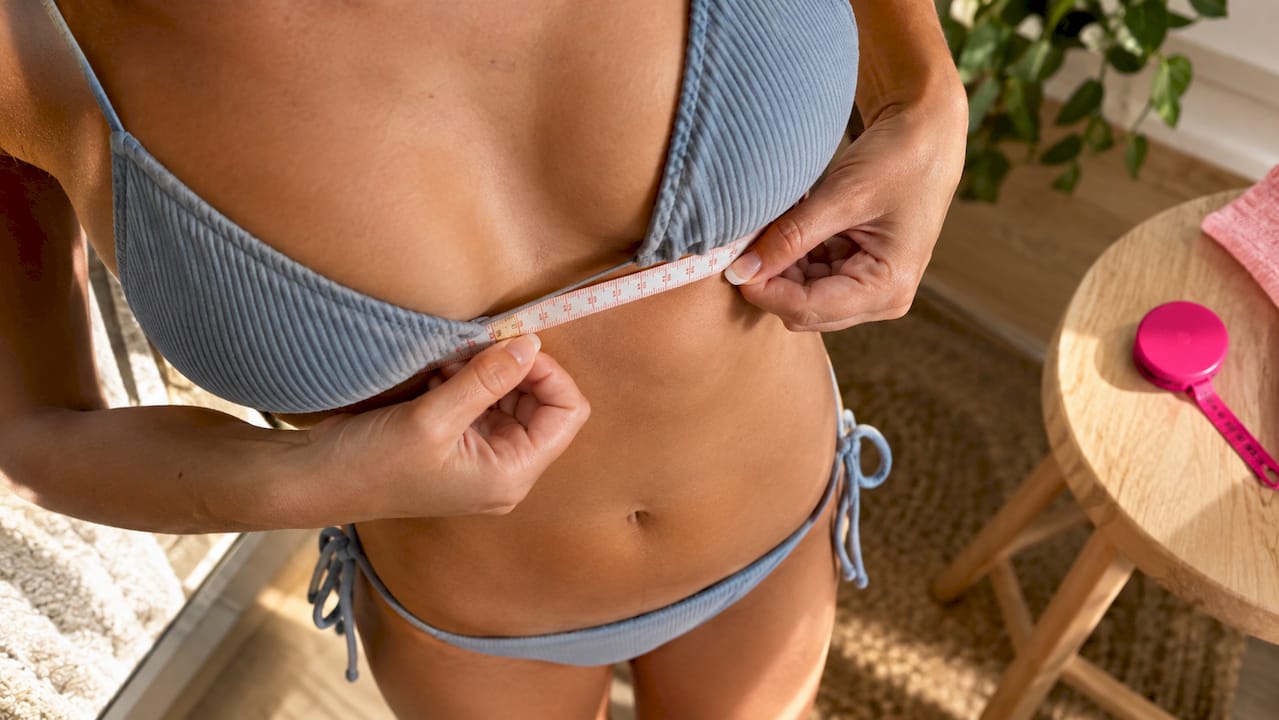
Most swimwear brands that use bra-sized charts convert those two numbers into a familiar band and cup combination, so if you already know your bra size, you have a strong starting point. Brands that only offer S, M, L, and XL require more guesswork, which is one reason bra-sized retailers with detailed size guides tend to produce better fit outcomes with fewer returns.
Once you have a size to try, run through this checklist before deciding it’s the right top:
- The band sits snug around the ribcage without riding up in the back when you raise your arms.
- The cup fully contains the breast with no spillage at the top or sides.
- The center gore lays flat against your sternum instead of standing away from your body.
- Straps sit securely on the shoulder without slipping, even after adjustment.
- There’s no gaping at the top of the cup when you lean forward and stand back up.
If the band digs in but the cups gape, you likely need a smaller band with a bigger cup. If the band feels loose but the cups feel tight, go up in band and down in cup. This inverse relationship confuses a lot of shoppers the first time, but it’s the same logic that governs bra sizing and it applies just as directly to swim tops.
Pro Tip: If your top and bottom don’t naturally match in size, buy them separately instead of settling for a fixed set. A larger bust paired with a smaller waist or hip is common, and buying pieces individually lets each half fit correctly instead of averaging out to a compromise that fits neither well.
Size up when you need more range of motion, for swimming laps or chasing kids through waves, since a slightly looser cup with a firm band still holds shape without restricting movement. Size down, within reason, when containment is the priority and you’re mostly lounging poolside. Before finalizing any order, confirm the seller’s return policy and check the size chart against your actual measurements rather than your usual clothing size. A detailed sizing guide that maps measurements to specific band and cup combinations will save you a return shipment more often than guessing based on a size label alone.
How Can You Style a Bikini to Flatter a Sagging Bust?
The right bottom does more for your silhouette than most people expect. High-waisted bottoms create a continuous line from ribcage to hip, which balances a fuller bust by adding visual weight below the waist instead of leaving all the attention up top. Testers who evaluate supportive swimwear regularly note that pairing a supportive top with a high-waisted, ruched bottom creates a more balanced overall shape and, just as important, tends to make the wearer feel more confident in it.
Ruching does similar work through texture instead of cut. Gathered fabric around the waist or hip catches light unevenly, which softens the eye’s read on your midsection and shifts focus away from the bust. A ruched top and bottom set built with this in mind pulls double duty: it flatters the same way ruched bottoms do while adding light structure through the gathered panel.
Seam placement matters more than most shoppers realize. Vertical seams running down the center or sides of a top elongate the torso and break up the visual mass of the bust, while a top with no seaming at all, especially a stretchy triangle style, tends to create what’s often called uniboob, where both cups merge into a single shape with no defined separation. A center gore or vertical seam down the middle of the top prevents that by giving the eye a clear break between the two cups.
Neckline choice changes the entire visual effect:
- A deep plunge draws the eye down the centerline and can elongate the torso, but it offers the least physical support of the three.
- A sweetheart neckline curves along the top of the cup, adding shape without a straight-across line that can look severe on a fuller bust.
- A high neck covers more skin and redirects attention upward toward the collarbone and face, which some readers prefer specifically because it shifts focus away from the bust entirely.
Color and pattern do quieter work in the background. Darker solid tops read as more minimizing than bright prints, since large-scale patterns tend to add visual volume. Vertical stripes lengthen rather than widen, and structured details like a wide band, a defined seam, or a contrast trim redirect attention toward the shape of the garment instead of the shape underneath it. None of this changes how the top functions, but it changes how it reads at a glance, and for a lot of shoppers, that’s just as important as the fit itself. A high-waisted bottom styled with the right proportions can shift an entire outfit’s balance without touching the top at all.
What Fabric and Construction Choices Keep a Bikini Supportive Over Time?
Fabric quality determines whether a top still supports you by the end of the season or goes slack after a handful of wears. High-compression blends with strong elastic content hold their shape wash after wash, while thin, single-layer fabric stretches out permanently within a few uses, especially around the cup and band where tension is constant.
Lining matters just as much as the outer fabric. A lined cup keeps its shape independent of the swimsuit’s outer layer, which is part of why sewn-in, lined support consistently outperforms glued or unlined construction in long-term wear. Glued cups are a shortcut in manufacturing, and they show it: the bond weakens with sun, chlorine, and salt water, and once it fails, the cup loses its shape for good.
A short care routine extends the life of any supportive top:
- Rinse the suit in cool water immediately after swimming to remove chlorine or salt before it sets into the fabric.
- Avoid hot water and never put swimwear in the dryer, since heat breaks down elastic fibers faster than almost anything else.
- Dry flat in the shade rather than direct sunlight, which fades color and weakens elastic over time.
- Rotate between two suits if you swim often, giving the elastic time to recover between wears instead of staying stretched under constant use.
Replace a top once the band no longer snaps back after stretching or the cup visibly loses shape when it’s dry. At that point, no amount of careful washing brings the support back.
What I’ve Learned Answering Fit Questions From Shoppers
The same handful of fit questions come up again and again: “Why does the band feel fine but the cup gapes?” or “Should I just buy a size up to be safe?” The honest answer is that sizing up rarely fixes a support problem. A looser cup on a bigger band just moves the gap somewhere else. The fix is almost always a band and cup adjustment in opposite directions, not a blanket size change.
The biggest mistake shoppers make is buying by overall size label instead of by band and cup measurement. A “large” top from one brand and a “large” from another can differ by two full cup sizes once you actually measure them side by side. That’s why a real sizing guide, not a generic size chart, matters so much. An online retailer carries structured tops, ruched sets, high-waisted bottoms, tankinis, and one-piece swimsuits across a range of sizes, and the site’s filters let you narrow by style, price, and product type instead of scrolling through everything at once.
Use the site’s sizing resources before you buy, not after something doesn’t fit. Filter by structured or supportive styles first, check the size guide against your own measurements, and if your top and bottom sizes don’t match, buy them as separates instead of forcing a set. That one habit prevents more returns than anything else in this guide.
— Ryan
How Doll House Bikinis Fits Into Your Support Search
Doll House Bikinis carries structured tops with built-in band support, ruched styles that flatter through texture, and high-waisted bottoms designed to pair with either, which covers nearly every recommendation in this guide without forcing you into a single fixed set.
Three categories map directly onto what actually works. The structured swimsuit gives you built-in support in a one-piece format, useful if you’d rather skip the top-and-bottom sizing puzzle entirely. The ruched bikini top and tie-side bottom set pairs the balancing effect of ruching with a coordinated bottom, so you get the styling benefit this guide covers without piecing it together yourself. And the swimwear sizing guide walks you through matching your measurements to an actual band and cup combination instead of guessing from a generic S, M, L chart.
Free shipping on orders over a certain amount makes ordering a top and a bottom separately, exactly what this guide recommends when your sizes don’t match, a lot less of a financial gamble. Start with the sizing guide, check your measurements against it, and browse the structured and ruched styles that match what your body actually needs this season.
Sources
The recommendations above draw on a mix of editorial testing, retail fit guidance, and first-person reviews rather than any single source.
- The Best Supportive Swimsuits of 2026, Tested and Reviewed
- My hunt for flattering swimsuits for women over 60
FAQ
How Do You Lift Saggy Breasts in a Swimsuit?
An underwire or bra-sized top with molded or sewn-in cups and a firm underband provides the most reliable lift, since the wire and band do the structural work that padding alone can’t. Wide, adjustable straps add extra support by distributing weight across the shoulder instead of letting the cup carry it alone.
What Is a Pubikini?
The term isn’t a recognized swimwear category or a feature discussed in fit guidance for sagging or fuller busts. If you’re looking for support-focused terminology, “bra-sized swimwear” or “underwire bikini top” are the standard industry terms to search for instead.
What Should You Wear if You Have Saggy Breasts?
Look for underwire or full-cup tops, longline styles with extra underbust coverage, or halter necklines with wide straps, then pair any of them with a high-waisted or ruched bottom to balance the silhouette. Buying the top and bottom in separate sizes, rather than as a fixed set, usually improves fit more than switching styles alone.
Which Bathing Suits Offer a Breast Lift?
Bra-sized underwire tops, longline tops with a built-in band, and halter styles with steep strap angles all create lift through construction rather than padding. Editorial testing consistently ranks these three approaches above styles that rely on removable pads or thin, unlined fabric.