
Underwire bikinis are the right choice when you want consistent lift, defined shape, and a top that stays in place through water, movement, and long beach days. The structured wire beneath each cup does work that fabric alone cannot: it separates, lifts, and holds the cup’s lower edge firm whether the suit is wet or dry. Three reasons stand out most: real structural support that takes weight off your shoulders, a sculpted silhouette that holds its shape all day, and active-fit stability for paddleboarding, swimming, or any beach sport. Dollhousebikinis carries well-constructed underwire styles built with these priorities in mind.
- Support: The wire distributes breast weight into the band, reducing neck and shoulder strain.
- Shape: A rigid lower cup edge creates defined lift and separation that fabric-only tops lose when wet.
- Stability: Structured cups stay in position during movement, making underwire the practical choice for active water use.
Table of Contents
- What is an underwire bikini and how does it work?
- Why choose underwire bikinis for support, lift, and active wear
- Who gets the most out of an underwire bikini?
- What underwire bikini styles do for your silhouette
- How to choose the right underwire bikini: fit checklist
- Pros, cons, and red flags to watch for
- How to care for underwire bikinis so they last
- Why construction quality matters as much as the wire itself
- Key Takeaways
- The case for underwire in a collection built around fit
- Structured styles worth trying at Dollhousebikinis
- Further reading and sources
What is an underwire bikini and how does it work?
An underwire bikini uses a semi-circular strip, typically steel or firm plastic, encased inside a fabric channel sewn beneath each cup. Its job is to lift, separate, and give the cup a rigid base so the shape holds regardless of what the fabric does. According to Wikipedia, steel remains the most common wire material in underwire swimwear because of its rigidity and shape memory, meaning it returns to its original curve after flexing.
The wire sits at the base of the breast, following the natural crease where the breast meets the chest wall. It connects to the underband on each side and terminates just short of the underarm. Above the wire, the cup fabric holds the breast; below it, the wire transfers load into the band. Straps then stabilize position rather than carry weight.
The wire’s real function is structural: it creates a fixed lower cup edge that the breast rests against, so the cup holds its shape even when wet fabric would otherwise go limp. Without it, cup shape depends entirely on band tension and seam construction, which can shift under water pressure or movement.
Fabric-only tops rely on stretch tension and seam placement to create shape. That works well in calm conditions, but once the fabric is wet and the tension changes, the cup can flatten or shift. The wire bypasses that problem entirely.
Why choose underwire bikinis for support, lift, and active wear
The core benefits of underwire swimwear are structural, not just aesthetic.
- Weight distribution: The wire moves breast weight into the underband rather than letting it pull on straps. For C cup and larger, this reduces shoulder and neck fatigue during long beach days or resort travel.
- Defined lift and separation: The rigid lower edge pushes the breast upward and keeps cups from collapsing together, producing a clean silhouette under a light cover-up or resort dress.
- Wet-fabric stability: Unlike fabric-only cups that can lose shape when soaked, underwire cups maintain their form during swimming and water sports because the wire holds the lower edge regardless of fabric tension.
- Posture support: A well-fitted underwire top encourages the shoulders back and chest forward, which matters on long travel days or when wearing a bikini as a top under a sheer shirt.
- Reduced bounce during activity: Structured cups plus a firm band limit movement during paddleboarding, beach volleyball, or a light swim, where a triangle top would shift or require constant adjustment.
Where underwire is not the best option: pure lounging on a flat surface, very minimal sun-bathing styles where softness and minimal coverage are the goal, or situations where a wireless bandeau or triangle top fits the aesthetic better. Wireless tops can outperform poorly made underwire tops, so the wire alone is not the deciding factor — construction quality is.
Who gets the most out of an underwire bikini?
The clearest functional gain goes to wearers with a C cup or larger, anyone doing active water sports, and anyone who wants a defined, bra-like silhouette rather than a soft, unstructured look. The wire distributes breast weight into the band, which directly reduces shoulder and neck strain that builds up over a full beach day.

For smaller busts, the picture is more nuanced. An A or B cup may not need the structural load-bearing function of an underwire, but the shaping effect is still real. A molded-cup underwire top can add projection and definition that a triangle top does not. The question is whether the added structure serves the look you want. For small-bust readers, Dollhousebikinis has a dedicated small-bust style guide that covers which structured options work best by cup depth and torso length.
Wide-set breasts benefit from a wider-set wire that follows the natural breast root rather than a narrow plunge wire, which can create gaps at the outer cup. Post-surgical shapes may need a softer wire or a specific cup depth to avoid pressure on scar tissue. Longer torsos often fit better in longline underwire styles that extend the underband coverage.
Pro Tip: If you wear a 34D in a bra, start with the same band and cup in an underwire bikini top. Swimwear sizing is not always identical to lingerie sizing, but it is the closest starting point. Adjust cup size up if the wire sits on breast tissue rather than below it.
What underwire bikini styles do for your silhouette
Different underwire styles produce noticeably different shapes. Knowing which one fits your goal saves a lot of trial and error.
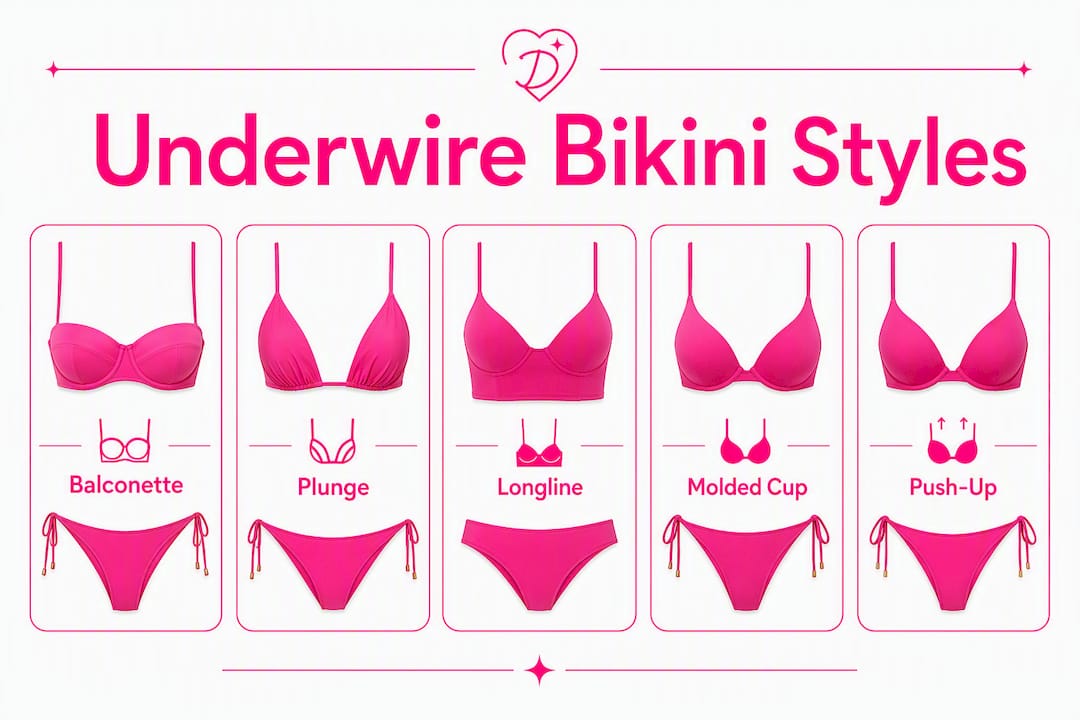
Balconette: A wide, shallow cup with a nearly horizontal neckline. The wire is set wide, which pushes the breast upward and outward, creating a rounded, full look at the top of the cup. Works well with strapless or off-shoulder cover-ups.

Plunge: A deep V-shaped center front with a narrow wire set close together. Creates cleavage and a long, open neckline. Best for wearers whose breasts sit close together naturally; wide-set shapes may gap at the outer cup.
Longline / extended underband: The underband extends several inches below the wire, adding torso coverage and extra stability. Looks like a bralette-style top and pairs well with high-waisted bottoms for a retro silhouette.
Molded cup: A pre-shaped foam or lined cup with an underwire base. Gives a smooth, rounded shape with no visible seam lines through thin fabric. Good for wearers who want a clean look under sheer cover-ups.
Push-up underwire: Adds angled padding at the base of the cup to push breast tissue upward and inward. Increases projection and cleavage more than a standard underwire alone.
Underwire one-piece: The wire sits beneath each cup in a one-piece suit, giving structured lift without a two-piece. Useful for wearers who want full coverage and support in a single garment.
How to choose the right underwire bikini: fit checklist
Fit is the deciding factor. A correctly sized underwire should encircle the breast tissue completely without sitting on it or digging into the ribs. Fit checks are the most reliable way to avoid the discomfort that gives underwire a bad reputation.
- Band level: The underband should sit horizontally across your back, parallel to the floor. If it rides up at the back, the band is too large or the straps are too tight.
- Wire placement: The wire must sit flat against your chest wall, following the natural breast crease. If it rests on breast tissue, go up a cup size. If it digs into the underarm, the wire is too wide for your frame.
- Cup containment: All breast tissue should sit inside the cup with no spillage at the top or sides. A gap at the top means the cup is too large; spillage means it is too small.
- Strap tension: Straps should lie flat and allow two fingers underneath. If they are doing the lifting, the band and wire are not fitted correctly.
- Back ride test: Lean forward 45 degrees. The band should stay level and the cups should not gape. If the back rides up, the band is too loose.
Movement tests: Raise both arms overhead, bend forward, and do a shallow jog in place. No spillage, no gaping, and a band that stays level are the signs of a correct fit.
Pro Tip: Before buying online, measure your underbust in inches for band size and your fullest bust measurement for cup size. The difference between the two (in inches) maps to standard cup sizing: 1 inch = A, 2 = B, 3 = C, 4 = D. Check the brand’s size chart against these numbers, and prioritize retailers with clear return or exchange policies so you can swap sizes without cost.
Pros, cons, and red flags to watch for
Pros:
- Consistent lift and separation that holds through activity and water
- Reduced shoulder and neck strain for fuller busts
- Defined silhouette that reads as polished under cover-ups or resort wear
- Size-inclusive support for C cup and above where wireless tops fall short
Cons:
- Less forgiving when breast volume changes (weight fluctuation, hormonal shifts)
- Visible seam lines from molded cups can show through very thin or sheer fabric
- A poorly fitted wire pokes, digs, or migrates, which is uncomfortable and distracting
- More care required than a simple triangle top
Red flags that signal poor fit or low construction quality:
- Wire moves side to side or pops forward during wear
- Wire pokes through the channel fabric at the center or underarm end
- Back band rides up constantly despite correct band size
- Straps are the only thing keeping the cups in place
- Wire sits on breast tissue rather than below it
A well-encased underwire should be undetectable during wear. Discomfort almost always signals a sizing or construction problem, not a flaw in underwire design itself.
How to care for underwire bikinis so they last
Proper care protects the wire channel, preserves elastic recovery in the band, and prevents rust or misshaping that shortens the life of a structured top.
- Rinse immediately after use. Saltwater, chlorine, and sunscreen degrade elastic and can corrode metal wires. Rinse in cool, clean water right after leaving the water.
- Hand-wash with a gentle detergent. Submerge the top in cool water with a small amount of mild detergent. Gently work the fabric without twisting or wringing. Machine agitation can bend or snap wires and deform cups. Dollhousebikinis’s bikini care guide covers detergent choices and wash frequency in detail.
- Reshape cups before drying. While the top is still damp, press the cups back into their original shape with your hands.
- Air-dry flat, away from direct sunlight. Lay the top on a clean towel in a shaded spot. Hanging a wet underwire top by the straps stretches the band and can pull the wire out of alignment. Direct sun degrades elastic and fades color faster.
- Inspect the wire channel regularly. Check the ends of the wire channel at the center front and underarm for any exposed wire or fraying stitching. Reinforcing a loose channel stitch early prevents the wire from breaking through entirely.
For storage, lay underwire tops flat or stack them cup-to-cup. Folding cups inward creases the molded shape and can crack foam lining. Never store a damp underwire top in a bag or enclosed space.
Why construction quality matters as much as the wire itself
Quality equals comfort in underwire swimwear. A well-encased, correctly sized wire in a coordinated cup pattern is what makes underwire work without pressure points. The wire alone guarantees nothing.
Construction hallmarks to look for when shopping:
- Fully encased wire channel: The wire should be completely covered by a smooth fabric channel with no exposed ends. Double-stitching around the channel increases longevity.
- Power mesh lining: A firm inner lining adds shape retention and prevents the outer fabric from stretching away from the cup structure.
- High-recovery stretch fabric: The outer fabric should return to its original shape after stretching. Low-recovery fabric loses cup shape quickly.
- Reinforced underband: A firm, wide underband does the structural work. A narrow or flimsy band shifts the load to the straps and wire, causing discomfort.
- Secure hardware: Rings, sliders, and clasps should be smooth-edged and rust-resistant. Cheap hardware corrodes and can scratch skin.
- Graded cup patterns: The cup shape should be sized proportionally across the size range, not simply scaled up or down uniformly. Poor grading is the main reason a wire fits one size perfectly and digs into the next.
Wireless tops sometimes outperform poorly made underwire tops, which is why construction quality matters more than the presence of a wire. Dollhousebikinis’s guide to structured bikini top features breaks down these construction details by style.
Pro Tip: Before buying, run your fingers along the wire channel from center front to underarm. The wire should feel smooth and fully enclosed with no hard endpoints pressing through the fabric. If you can feel the wire tip through the fabric in a new garment, the channel construction is inadequate.
Key Takeaways
Underwire bikinis deliver reliable support, defined shape, and active-fit stability that make them the best choice for C cup and larger wearers, active beach use, and anyone who wants a polished silhouette that holds when wet.
| Point | Details |
|---|---|
| Best for C cup and above | The wire distributes breast weight into the band, reducing shoulder and neck strain for fuller busts. |
| Fit determines comfort | A wire that sits on breast tissue or digs into the underarm signals the wrong cup size or wire shape, not a flaw in underwire design. |
| Construction over price | Fully encased wire channel, power mesh lining, and high-recovery fabric separate a comfortable top from a problematic one. |
| Care extends lifespan | Rinse after use, hand-wash, reshape cups, and air-dry flat to protect the wire channel and preserve band elasticity. |
| Dollhousebikinis underwire styles | Dollhousebikinis offers well-constructed underwire and structured tops with fit resources to help shoppers find the right size and style. |
The case for underwire in a collection built around fit
Underwire styles appear in Dollhousebikinis’s collection because fit-forward design is the brand’s focus. A playful, bold aesthetic only works when the top actually stays in place. Underwire gives that reliability, especially for wearers who want a defined silhouette for resort dining, active beach days, or travel. The brand’s quality swimwear features guide and step-by-step buying guide are the right starting points for shoppers who want to match construction quality to their fit needs before choosing a style.
Structured styles worth trying at Dollhousebikinis
Dollhousebikinis’s two-piece swimwear sets include underwire and structured top options built with the construction details covered in this guide: encased wire channels, lined cups, and reinforced underbands. The push-up underwire three-piece set is a direct example of the brand’s structured category.

Use the fit checklist from this guide when browsing: check band size first, then cup depth, then wire width relative to your breast root. Dollhousebikinis’s size guidance and exchange options make it straightforward to find the right fit without guesswork. Browse the two-piece sets and apply the movement tests at home before committing to a style.
Further reading and sources
- Underwire bra construction and materials — Wikipedia
- Underwire Bikini: A Complete Guide — Decisive Beachwear
- Bikini Care Guide — Dollhousebikinis
- Why Choose Structured Bikini Tops — Dollhousebikinis
- Features of Quality Swimwear — Dollhousebikinis