
Most shoppers grab a bikini set, assume the top and bottom are just two matching halves, and call it done. But if you’ve ever had a bottom that gaps at the leg or a top that slides out of place the moment you hit the water, you already know something is off. Understanding what is the difference between bikini tops and bottoms goes well beyond aesthetics. These two pieces are built differently, engineered for different body zones, and constructed with different technical priorities. This article breaks all of that down so your next swimwear purchase actually works for you.
Table of Contents
- Anatomy of bikini tops vs bottoms
- Functional differences in support and coverage
- Construction and engineering differences
- Mix and match: pairing tops and bottoms for your best fit
- Why understanding bikini tops and bottoms goes beyond style
- Explore stylish bikini tops and bottoms at Doll House
- Frequently asked questions
Key Takeaways
| Point | Details |
|---|---|
| Distinct functions | Bikini tops support and cover the bust, bottoms cover hips and provide comfort at leg openings. |
| Style variety | Tops and bottoms come in many styles offering different coverage and support levels to fit your needs. |
| Construction matters | Fabric cuts, seams, and closures are engineered differently for tops and bottoms to enhance fit and comfort. |
| Mix and match | Separates allow you to tailor fit and style independently for better swimwear satisfaction. |
| Informed choices | Understanding differences helps avoid fit issues and increases swimwear durability and comfort. |
Anatomy of bikini tops vs bottoms
The clearest way to understand the difference in swimwear is to look at what each piece is made of and why. Every component has a job.
Bikini top components:
- Cups: The shaped sections that hold and cover the bust
- Apex: The point where the cup meets the strap, critical for distributing bust weight
- Bridge: The center section connecting the two cups
- Wings: Side panels that wrap toward the back for stability
- Straps: Shoulder and/or neck straps that carry load from the bust
- Closure: Back clasp or tie that secures fit
Bikini bottom components:
- Front panel: The main coverage area over the abdomen and pelvic zone
- Back panel: Coverage over the rear, varies widely by style
- Gusset: The fabric section between the legs, designed for comfort and hygiene
- Waistband: Elastic or fabric band that anchors the bottom at the hip
- Leg openings: Cut and shaped to fit the thigh without digging or gaping
- Back seam: Runs through the rear panel and affects coverage level
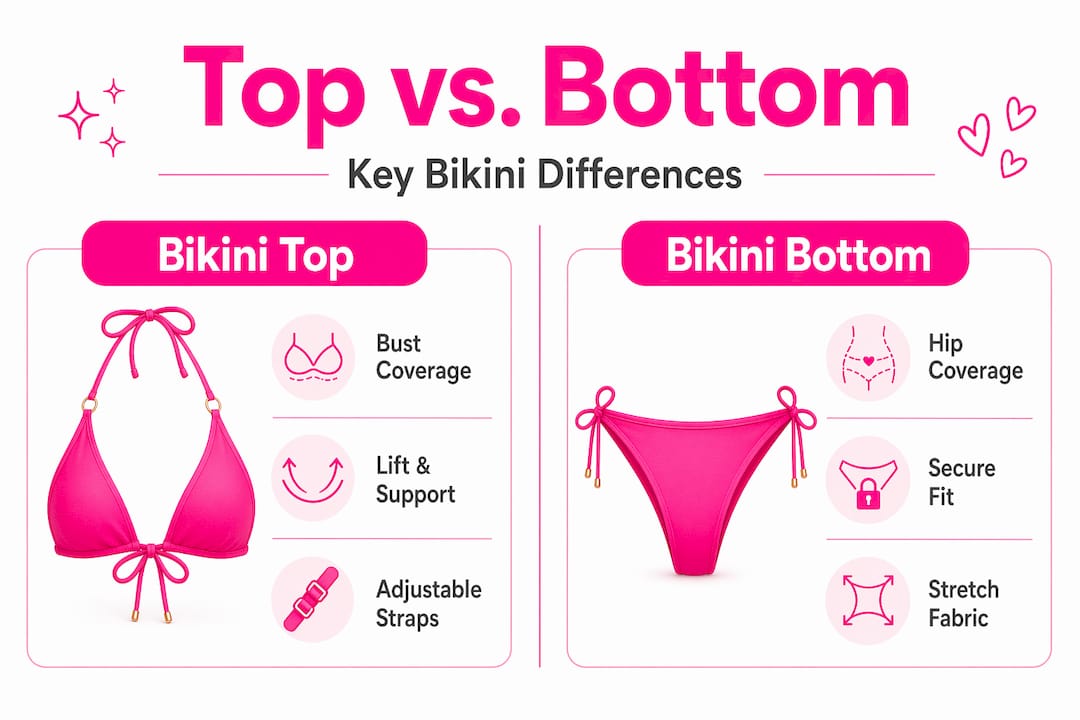
As swimwear anatomy guides explain, a bikini top is primarily responsible for bust coverage and lift/support, while the bottom handles coverage around the hips and rear and ensures comfort at the leg openings. These are not the same engineering problems, which is why the construction differs so significantly.
The apex in a top is a surprisingly important detail. When a top fits well, tension from the bust weight travels up the strap smoothly through the apex. When it does not, the cups migrate inward or the top rides up. In bottoms, the gusset does the equivalent job. A well-cut gusset prevents friction and bunching between the legs during movement. Both details are invisible when they work and very noticeable when they do not.

Making perfect swimwear choices starts with knowing these components exist and understanding what they do for your fit.
Now that we know what parts make up bikini tops and bottoms, let’s look more closely at how each piece functions differently.
Functional differences in support and coverage
The bikini top vs bottom comparison gets most interesting when you look at what each piece actually needs to accomplish during wear. They solve different problems.
Bikini tops handle bust support. The range is wide. Triangle bikini styles offer minimal coverage with adjustable ties, making them light and flexible but low on structured support. Underwire tops function almost like a bra, with structured bust support built directly into the cup. High-neck tops provide additional chest coverage and reduce movement. Bandeau tops sit straight across the chest with no straps at all. Each style represents a different trade-off between coverage, support, and visual style.
Bikini bottoms, by contrast, vary primarily by rise and rear coverage. The main categories:
- High-waisted: Covers the midsection, sits above the hip bone
- Mid-rise: Standard coverage, sits at the natural waist
- Cheeky: Sits lower on the rear, shows more of the glutes
- Thong: Minimal rear coverage, thin back panel
- Brazilian: Low rear coverage similar to cheeky but slightly more structured
- Boyshort: Full rear and hip coverage with a straight leg opening
Here is a quick comparison of bikini top styles vs bottom types by their key function:
| Style | Type | Primary function |
|---|---|---|
| Triangle | Top | Light coverage, adjustable |
| Underwire | Top | Structured bust support |
| Bandeau | Top | Strapless, minimal hardware |
| High-waisted | Bottom | Midsection coverage, retro silhouette |
| Cheeky | Bottom | Rear exposure, tan line reduction |
| Thong | Bottom | Minimal coverage, no tan lines |
| Boyshort | Bottom | Full coverage, active wear |
Pro Tip: Choose your top based on how much bust support you need, and choose your bottom based on how much rear coverage feels comfortable to you. These are separate decisions, not one package deal.
One practical benefit of understanding bikini top styles and bikini bottom types separately is that you can buy them independently. A floral ruched bikini top and tie side bottom set can give you a coordinated look while still letting you size each piece correctly for your proportions.
Understanding the function and style variety helps clarify why tops and bottoms differ so much in design and construction.
Construction and engineering differences
This is where the bikini top vs bottom difference becomes technical. And it matters more than most shoppers realize.
Bikini bottoms rely on a principle called negative ease. That means the bottom is cut smaller than the body measurements it is meant to fit. The stretch of the fabric does the work, pulling the garment snug against the body. This is why flat measurements alone do not tell the full story when buying bottoms online. A bottom that looks too small on a hanger may actually be the right size once it stretches into place on your body.
Bikini tops use a different construction logic. The apex point must handle real mechanical load. Reinforced stitching and sometimes boning or underwire at the apex ensures the bust weight distributes across the strap rather than pulling down on the cup fabric. When this fails, the top stretches out, the cups lose their shape, and support drops quickly.
Key construction differences at a glance:
- Bottoms use negative ease for snug, secure fit during movement
- Tops use reinforced apex and strap points to handle bust weight
- Quality swim bottoms include gussets and flatlock stitching to reduce chafing at high-friction zones
- Tops prioritize secure closures and strap adjustability for long-term shape retention
- Seam placement in bottoms focuses on the inner thigh and leg opening to prevent digging
“Negative ease allows bikini bottoms to stay in place comfortably despite wearing wet or moving actively.”
Pro Tip: Before committing to a new bikini, put it on, then move. Swim, bend, sit, and walk. Construction problems show up immediately in motion, not while standing still in a fitting room.
The two piece tassels top bikini is a good example of a design where strap construction and top detailing directly affect how the piece holds up during wear, not just how it looks in photos.
Having explored how bikini styles differ functionally, let’s look at the practical impact of these construction details on your swimwear experience.
Mix and match: pairing tops and bottoms for your best fit
Now that you know how tops and bottoms differ in design and construction, applying that knowledge to your shopping process becomes straightforward.
The biggest practical advantage of understanding the bikini top vs bottom difference is that you do not have to buy matching sets. Separate sizing gives you control. If you are a size small on top and a size medium on the bottom, buying separates is not just an option, it is the smarter choice.
Mixing and matching is also a way to build more looks from fewer pieces. A patterned top pairs cleanly with a solid bottom. A bold color on top balances with a neutral bottom. Style contrast, like a structured bandeau with a flowy high-waisted bottom, creates visual interest without looking mismatched.
Tips for mixing tops and bottoms:
- Match scale: pair bold prints with solid or subtle patterns
- Use a shared color: pull one shade from the top’s print for your bottom color
- Contrast silhouette: structured top with relaxed bottom, or minimal top with covered bottom
- Consider activity: high-support top for swimming, minimal top for lounging
Step-by-step guide to choosing your mix-and-match bikini:
- Know your body shape. Identify where you want coverage and where you want exposure.
- Pick your top style for support. Decide how much bust support you need before focusing on aesthetics.
- Choose your bottom style for coverage. Think about rear coverage comfort and the leg opening that works best for your build.
- Consider fabric and construction. Check for flatlock seams in bottoms and reinforced apex in tops.
- Try on and test movement. Walk, sit, and if possible, get wet to test real-world fit.
Pro Tip: When buying online, order two sizes and test both with movement before returning the one that does not perform. Sizing in swimwear varies significantly across brands and styles.
The choosing perfect bikini fit guide offers additional insight into how body shape interacts with swimwear design decisions.
Why understanding bikini tops and bottoms goes beyond style
Here is an honest take: most shoppers buy bikinis the same way they buy fast fashion. They look at a photo, pick a color they like, and order their usual size. Then they wonder why the top digs in at the back or the bottom creeps up every time they swim.
The trend-first approach skips the construction knowledge that actually determines whether a swimsuit works. Knowing what a gusset does, why negative ease exists, and how the apex handles bust weight means you stop blaming your body for fit problems that are actually garment problems. That shift in perspective leads to better purchases, longer wear life, and real comfort at the beach.
There is also a confidence element that does not get talked about enough. A bikini that is engineered to fit your proportions does not require constant adjusting. You stop pulling your top down or tugging your bottom up every few minutes. You just wear it. That is what good construction delivers.
“A bikini is more than a simple two-piece swimsuit. Every component plays a vital role in function and quality.”
Informed buying also protects your investment. Quality swimwear is not cheap, and knowing what construction details to look for means you identify durable pieces rather than discovering problems after two pool visits. Details like flatlock stitching, reinforced apex points, and proper gusset construction are signs of garments built to last.
Pro Tip: Do not let trends drive every decision. Pick pieces that genuinely fit your activity level and body shape. A well-fitted bikini from last season outperforms a poorly fitted one from this week’s new arrivals every time.
The swimwear choices insights resource covers additional factors that help you make long-term confident decisions about swimwear.
Explore stylish bikini tops and bottoms at Doll House
With a clear understanding of how bikini tops and bottoms differ in function, construction, and fit, you are ready to shop with purpose.

Doll House Bikinis carries a full range of bikini tops and bottoms sold as both sets and separates, so you can size each piece for your body without compromise. The catalog covers every major style category discussed in this article.
- Two-piece set swimwear: Coordinated sets with consistent construction across top and bottom
- Floral ruched bikini set: Ruched detailing with adjustable tie-side bottom for flexible fit
- The Original swimsuit collection: Classic styles built with quality fabric and construction you can feel
Free shipping is available on orders over $100. Browse by style, coverage level, and size to find pieces that match both your look and your fit needs.
Frequently asked questions
What is the main functional difference between bikini tops and bottoms?
Bikini tops primarily provide coverage and support for the bust, while bikini bottoms focus on coverage and comfort around the hips and rear. These are different structural jobs, which is why the two pieces are built differently.
Can I mix and match different styles of bikini tops and bottoms?
Yes. Mixing and matching different styles and sizes lets you find the right fit and coverage for your top half and bottom half independently, which is often more flattering than a matching set in the wrong size.
Why do bikini bottoms use negative ease in their construction?
Negative ease means the bottom is cut smaller than body measurements so the stretchy fabric holds the piece securely in place during movement and water exposure, preventing gaping or riding up.
What should I consider when choosing a bikini top for support?
Look for underwire tops or designs with a reinforced apex and straps if you need structured bust support, similar to what a bra provides. Triangle tops and bandeaus work well for lighter support needs.
Recommended
- One piece vs bikini: Choose your perfect swimwear | News - Doll House
- What is a tankini? Style, fit, and benefits explained | News - Doll House
- Thong Bikinis Explained: Confidence, Comfort & Style Guide | News - Doll House
- Triangle Bikinis Explained: Stylish Swimwear Options & Trends | News - Doll House