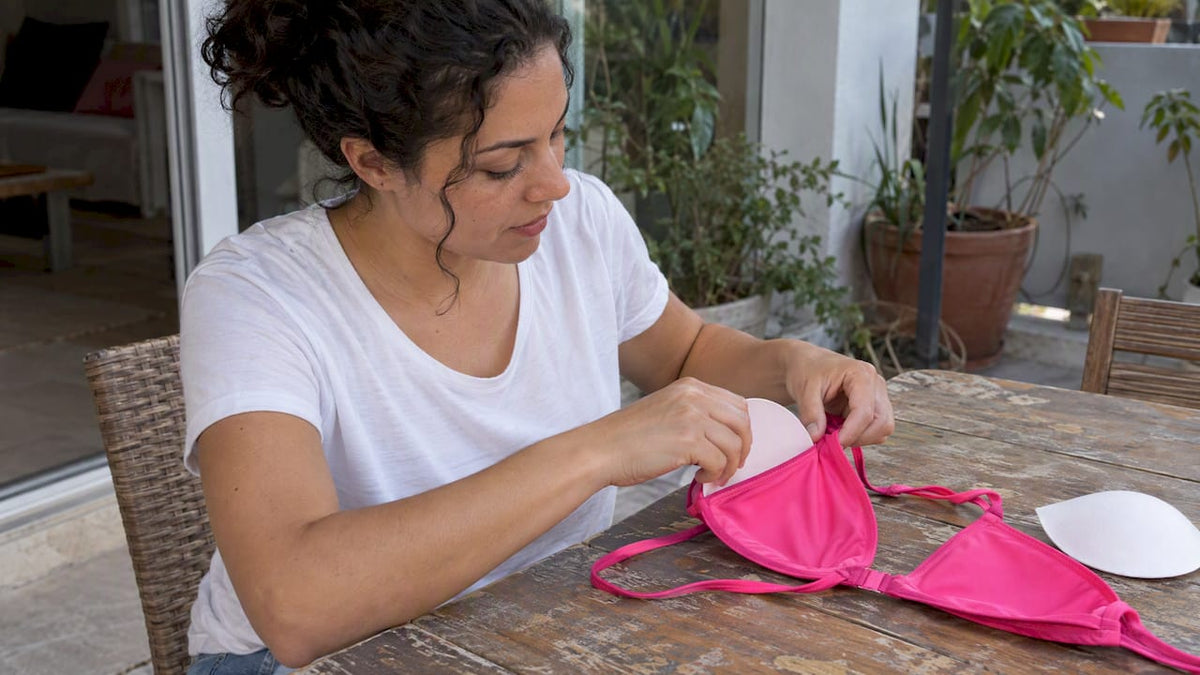
Padding can be added to a bikini top in three ways: slide a removable insert into an existing pocket, sew a small pocket or liner into the lining, or use a bikini top that already has built-in padding. The first method takes about five minutes and needs no tools. The right choice depends on the top style, the fabric, and what the padding is meant to do: add volume, smooth the shape, or give coverage.
This guide covers each method step by step, which tops accept inserts and which do not, how to test a pad in water, and when buying a pre-padded style is simpler.
TL;DR
- Check the top first. Triangle and halter tops with pockets or removable cups take inserts best. Very small micro tops often cannot hold one.
- Thickest part of the pad goes at the bottom of the cup. Roll the pad, slide it in, then flatten and smooth it from outside the fabric.
- No pocket: sew a simple pocket or liner by hand, or choose a top with padding built in.
- Padding adds shape and coverage. It does not replace support from the band and straps.
- Test wet, not only dry. Thick foam absorbs water and can shift or change the silhouette.
Table of Contents
- What padding does, and what it does not
- Which bikini tops accept padding
- Choosing the right insert
- How to insert a pad into a bikini top with a pocket
- What to do if the top has no pocket
- Do the wet test
- Washing and care
- Common problems and fixes
- Our view on padding
- Padded options at Doll House
- FAQ
- Sources
What padding does, and what it does not
Padding adds volume, rounds the shape, and covers the nipple area under thin or wet fabric. It is an aesthetic layer. Support comes from the underbust band, strap tension, and cup construction. A top that slides, digs in, or lets the bust fall out of the cup will not be fixed by a pad dropped inside.
This matters for the purchase decision:
- Padding (foam or similar): shapes and covers.
- Cups: a structured shape sewn or molded in, which also holds the top’s form.
- Underwire or structured construction: provides lift and holds the bust in place. See the guide to why structured bikini tops give support and style and the overview of underwire bikinis.
If the top feels loose or tight before any padding goes in, fit is the problem. The steps in Is Your Bikini Top Too Small? are worth running first.
Which bikini tops accept padding
Not every style works with every insert. Compatibility comes down to surface area and whether the fabric has somewhere to hold the pad.
| Top style | Works with inserts? | Notes |
|---|---|---|
| Triangle | Usually yes | Best with a pocket or liner. Triangle-shaped or half-moon pads sit well. Details in Triangle Bikinis Explained. |
| Halter | Usually yes | Neck tie carries the weight, so the pad stays in place if the cup is lined. |
| Bandeau | Yes, with thin pads | Thin, full-coverage pads work best. Thick pads can fold at the straight edge. |
| Underwire or molded cup | Often already padded | Adding more can crowd the cup. Check the cup before adding anything. |
| Micro and string tops | Rarely | Small fabric area. Pads tend to shift, fold, or show at the edges. |
The fastest check is the product description. Look for terms such as “push-up,” “lightly padded,” “removable cups,” or “padding pocket.” Product photos help too: visible seams or a structured cup edge usually mean a pocket or built-in cup. For a comparison of the two most common shapes, read the triangle vs. bandeau top guide.
Choosing the right insert
Inserts differ in material, thickness, and shape. Pick by the result wanted.
Foam pads
Foam pads are the most common and the cheapest. They come in thin, medium, and thick versions. They are light when dry, but thick foam holds water and can feel heavy and slow to dry. Cornell researchers working on functional apparel for comfort and hygiene point out that molded foam pads commonly inserted in swimsuits restrict airflow and hold heat and moisture against the skin. For long beach days, thinner pads or breathable alternatives are the more comfortable option.
Silicone or gel inserts
These add more volume and a more rounded shape. They are heavier, and the top needs to be sturdy enough to carry them. A thin, unlined triangle top will often sag or twist under a gel insert.
Lattice or open-structure pads
These are designed to let air and water through. They rinse and dry faster than solid foam, which suits swimming and humid weather.
Shape and thickness
- Triangle or crescent shape: thick at the bottom, thin at the top. Gives a lifted, rounded look.
- Round, even-thickness: smooth and natural. Suits bandeau and lightly lined tops.
- Thin cover pads: mainly for coverage and a smooth surface rather than added size.
Size the pad to the cup. A pad larger than the cup will bunch or push out at the edge. A pad smaller than the cup will slide around.
How to insert a pad into a bikini top with a pocket
This is the standard method, and it takes about five minutes.
- Match the pad to the cup. Hold the pad against the top. The outline should fit inside the cup area without edges reaching the seams.
- Find the opening. The slit is usually at the inner or lower edge of the cup, along the lining seam. Open it with two fingers.
- Roll the pad. Roll it as tightly as it will go. A tight roll passes through a small slit with less pulling.
- Feed it in. Slide the rolled pad in and let it unroll inside the cup. Thickest part at the bottom.
- Flatten and smooth. Work the pad flat from the outside. Push the edges into the corners. Make sure no pad outline shows through the fabric.
- Repeat on the other side, then compare both cups in a mirror. Adjust until they match.
- Move around. Lean forward, raise both arms, and turn. If a pad slides or bunches, take it out and try a different shape or size.
A very small slit may leave the pad hard to flatten. Gently pull the opening wider with a fingertip rather than forcing the pad, which can tear the seam.
What to do if the top has no pocket
Pockets are not standard. Three options cover most cases.
Option 1: sew a small pocket
For a lined top, a hand-sewn pocket is the neatest fix. Instructions for adding padding to an unpadded bikini top describe lining the inside of the top with padding. The steps below apply the same idea:
- Lay the top flat, inside out.
- Place the pad in the cup and mark its outline with a few pins.
- Cut a small piece of lining fabric slightly larger than the pad.
- Stitch it to the inside of the cup on three sides using small, even stitches or a stretch stitch. Leave one side open, usually the inner edge.
- Turn the top right side out, insert the pad, and check the stitches do not show from outside.
Use thread that handles stretch and water. Avoid stitching through the outer fabric in a way that leaves visible dots.
Option 2: sew the pad in
Sewing the pad directly to the lining is permanent. The pad cannot be removed for washing, and foam will take longer to dry. This is a poor fit for frequent swimmers.

Option 3: adhesive options
Some people use adhesive bra cups or fashion tape. These hold only if the skin is dry and free of oil or sunscreen, and they are less reliable in water. They are best for short, dry wear such as poolside photos.
Option 4: replace the top
If the top is thin, tiny, or stretched, adding padding often means fighting the design. A top with padding built in saves the effort. See push-up bikini tops for what to look for.
Do the wet test
A top can look well shaped when dry and behave very differently in water. Foam absorbs water, gets heavier, and can pull on thin fabric. A pad may drift toward the underarm, fold at the center, or reveal gaps in the cup that were not visible on land.
Before wearing a padded top for a full day:
- Wet the top and the pad in a sink or shower, then put it on.
- Move as planned: swim a few strokes, bend, sit, and lift the arms.
- Check for edges showing, pads floating up, and cups that gape.
- Note how long it takes to dry. If the pad stays soggy for hours, a thinner or open-structure pad is a better choice.
A dry fit alone is not enough.
Washing and care
Removing the pads before washing is the simplest rule. Rinse the top in cool, fresh water after swimming. Squeeze the pads gently rather than wringing them, and let them air dry flat, away from direct heat. Heat and chlorine break down foam and elastic faster. Leaving damp pads in a closed bag can lead to odor and skin irritation.
Common problems and fixes
| Problem | Likely cause | Fix |
|---|---|---|
| Pad bunches at the edge | Pad too large for the cup | Trim slightly or choose a smaller size |
| Pad outline shows | Thin or light-colored fabric | Use a thinner pad or one that matches the fabric color |
| Pads slide toward the sides | Slit too big, or no pocket | Sew the slit partly closed, or add a liner |
| Top still sags with pads in | Band or straps too loose | Adjust ties or size down; padding does not provide support |
| Pad folds in the water | Foam too thick or soft | Switch to a firmer or open-structure insert |
| Skin feels hot or irritated | Foam holds moisture | Use a thinner or breathable insert and change out of wet swimwear |
A saggy bottom is a separate matter: that points to stretched fabric or the wrong size. The guide to bikini tops and bottoms explains how the two pieces are cut differently.
Our view on padding
We see padding questions from shoppers who want a change in shape without replacing the whole suit. Our approach is practical. Add a pad when the top already fits and the goal is shape or coverage. Do not use a pad to fix a top that is the wrong size or lacks support.

When a top is too small, too stretched, or too minimal to hold an insert, a built-in option is the cleaner answer. Padded and push-up styles are sewn with the pad already placed, so nothing shifts, folds, or needs a slit. Our catalog groups these together, and product descriptions note the padding and styling so the choice can be made before checkout.
For most shoppers the best sequence is: check fit, check whether the style supports inserts, test wet, and only then decide whether to buy a pre-padded top.
— Ryan
Padded options at Doll House
For tops with padding already built in, the push-up bikinis and padded swimwear collection covers the range. Triangle, halter, and micro styles are listed on the bikini tops page, and matched pieces are on the bikini sets page. One example is the push-up underwire three-piece set. Orders over $100 ship free, and an email signup brings 10% off.
FAQ
Can you put a pad in a swimsuit that has no padding?
Yes, if the top has a lining or enough fabric area to hold it. Place a thin pad in a sewn pocket or liner. Tiny micro tops usually cannot hold a pad without it shifting or showing at the edges.
How do you put padding into a bikini top?
Roll the pad tightly, feed it through the pocket slit, and let it open inside the cup. The thickest part goes at the bottom. Smooth it flat from outside and compare both sides in a mirror.
What can be done if the bikini top has no pocket?
Sew a small pocket from lining fabric inside each cup, leaving one side open for the pad. Another option is to choose a top with padding already built in. Adhesive cups are a short-term choice for dry wear.
Does padding make a bikini top more supportive?
No. Padding changes shape and coverage. Support comes from the underbust band, strap tension, and cup construction. If the top moves or digs in, a better fit or a structured top is the fix.
Are foam pads fine for swimming?
They work, but thick foam absorbs water and holds heat and moisture against the skin. Thinner or open-structure pads dry faster. Test the pads wet before a long swim or beach day.
Sources
- Functional apparel designs improve comfort and hygiene, Cornell Human Ecology
- Adding Padding to a Bikini Top, LEAFtv