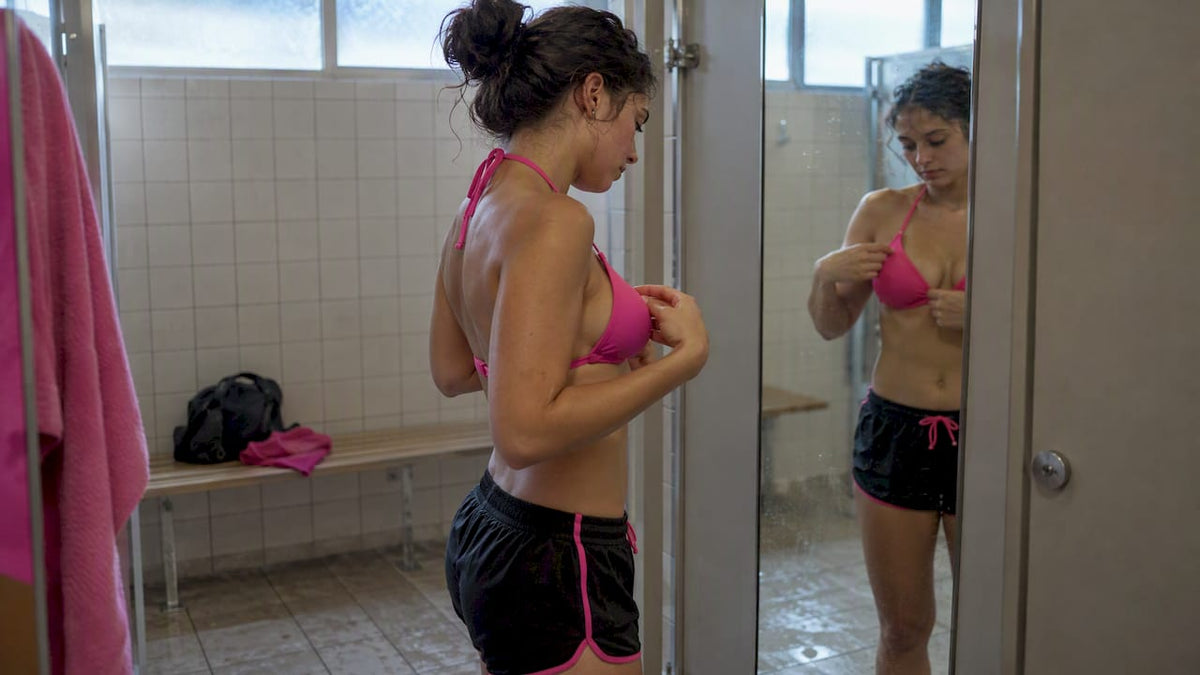
If straps dig in, cups leave spillage, or the top rides up when you raise your arms, your bikini top is probably too small. Start with the three-step manual adjustment: fasten the top, seat your tissue fully in each cup, then move around. Below, we cover quick fixes, alterations, measuring, and when to replace.
TL;DR:
- After seating your tissue fully in each cup, test the top by raising your arms, bending, twisting, and jumping; retest it wet if possible.
- A rising band often needs tightening, while digging straps may call for a looser band and shorter straps; removing pads can free cup space.
- Because brands use different size charts, measure your band and fullest bust, compare both figures with the chosen brand’s chart, and judge fit in motion.
- A band extender can add length but cannot create cup room, so persistent spillage calls for a larger cup or replacement, especially for swimming.
Table of Contents
- How can you tell for sure your bikini top is too small?
- What can you fix right now without sewing?
- Can you alter a bikini top to make it bigger?
- How do you measure for the right bikini top size?
- Which styles and features give more coverage?
- How do fabric and construction change fit?
- Should you alter, size up, or replace the top?
- What fixes actually work most often?
- Need a replacement? Start with our bikini tops
- FAQ
- Sources
How can you tell for sure your bikini top is too small?
A single bad moment in the mirror does not mean the top is a loss. Run a few checks standing still and in motion before you decide anything. These signs are the ones to look for:
- Straps digging into your shoulders or back. The band or the cups are too small, and the straps are doing the work the fit should do.
- Quad-boob. Tissue bulges over the top edge of the cup. The cup volume is too small for you.
- Side or back spillage. Tissue escapes at the sides or under the arms. Either the cup or the band does not match your frame.
- The top rides up. The band is too loose, or the cup shape is wrong for you. This one can look like a size problem when it is really a band problem.
- Edges cutting in. Red lines or indents after wearing the top mean the fabric has no room to give.
Next comes the movement test. Raise both arms overhead, bend forward at the waist, twist side to side, and do a few small jumps. Watch for tissue shifting out of the cups, the band sliding up your ribs, or straps pulling off your shoulders. A top that holds still through all four moves is doing its job.
Finish with a mirror or self-photo check. Take one photo from the front, one from each side, and one from behind. Look for clean cup edges, a band that sits level around your back, and no tissue pooling at the sides. Minor tweaks, like a slight strap shift, are normal. A bulge that comes back after every adjustment is a fit problem.
Fit can also change once the suit is wet. Some suits fit differently when wet, stretching or sagging in the water even when they felt fine dry. So test in motion, and if you can, test again after a dip. Our bikini fit guide walks through the same checks with illustrations.
What can you fix right now without sewing?
Quick fixes are reversible and take minutes. They also tell you whether the top is worth keeping. Start with the method swimwear experts recommend, which separates an unadjusted top from a true misfit.
- Fasten the top. Close the back clasp or ties. Some people close it in front and rotate it around, then pull the straps up.
- Seat your tissue in the cups. Lean slightly forward. Pick up each breast and pull it toward the center so it sits fully inside the cup. Many tops look too small only because the tissue was never placed properly.
- Check in a mirror. Look for quad-boob or spillage, then adjust the straps until the cup edges lie flat.
- Run the movement test. Raise your arms, bend, and twist. If the fit holds, the top may be fine as is.
If the top still fails after step four, try the adjustments below.
Straps and band. If the top rides up, tighten the band so it sits snugly under your bust. A snugger band takes weight off the straps, which can improve how the cups sit. If the straps dig in or the band squeezes your ribs, loosen the band one notch and shorten the straps slightly to compensate.
Padding. Many tops have removable pads. Moving a pad toward the outer edge changes where the cup holds volume. Removing a pad frees up space in the cup, and swapping in a thinner one can do the same. If the pads are sewn in, check that they have not shifted or bunched after washing.

Small hacks. A bra extender added to a hook closure gives you extra band length. Knotting tie straps a little higher or lower shifts the load on your neck and back. A small clip pulling the straps together behind your neck can give more front coverage on halter styles.
Pro Tip: Do the manual adjustment before you judge a top in the fitting room. Many returns come from tissue sitting outside the cup, not from a wrong size.
Our step-by-step fit guide shows these adjustments in more detail.
Can you alter a bikini top to make it bigger?
Yes, in many cases. Which route fits depends on what is too small: the band, the straps, or the cups. Cups are the hardest to change. Band and strap length are the easiest.
- Add a band extender. Sew a short strip of swim elastic or a hook-and-eye extender into the back closure. Difficulty is low to moderate, and it takes under an hour if you can hand-sew.
- Replace the swim elastic. Old elastic loses its grip, which makes a top ride up even when the size is right. Fresh swim elastic restores hold. This takes more patience, since you must open the seam and re-stitch it evenly.
- Lengthen the ties. Sewing on extra fabric or cord to the tie ends gives you more room to adjust. This is a simple fix for halter and tie-back styles.
- Swap or adjust the clasp. Replacing a fixed closure with an adjustable one gives you more band length without changing the cups.
- Use temporary fixes sparingly. A safety pin or clip is fine for a beach day. For regular wear, a sewn extender lasts much longer, and a pin can snag wet fabric.
Fabric matters here too. Swimwear stretches in specific directions, and swim elastic and material choice influence how a top holds its shape and resists chlorine and salt water. Use matching swim-grade materials, not regular sewing elastic, which breaks down in water.
If you are not comfortable sewing, take the top to a swimwear tailor or alteration shop. Tell them exactly what you want: “add an extender to the back band” or “replace the elastic along the bottom edge.” Bring the top clean and dry, and ask whether they have worked with stretch swim fabric before.
Pro Tip: Pin any extender in place and try the top on before sewing. Check it with the movement test, not just standing still.
Alterations have limits. If the cups are too small, extending the band will not fix quad-boob, and you may be better off with a different size.
How do you measure for the right bikini top size?
Measurements take the guesswork out of sizing, but they only work alongside each brand’s chart. Standard sizing does not exist across brands. A size labeled the same can fit very differently, so try multiple sizes and judge by how the top feels in motion, not by the label.
- Wear a thin, unlined bra or no bra. Padding adds inches that will skew the result.
- Measure your band. Wrap the tape around your ribs directly under your bust. Keep it level all the way around and snug, but not tight enough to press into your skin. Stand straight and exhale normally.
- Measure your bust. Wrap the tape around the fullest part of your chest. Keep the tape parallel to the floor and your arms relaxed at your sides.
- Note the difference. The gap between band and bust points toward cup volume. A bigger gap usually means you need more cup room.
- Compare to the brand chart. Match both numbers to the chart, not just one.
Cut matters as much as size. Triangle tops offer adjustable coverage but little support. Bralette styles give more coverage and a steadier band. Underwire styles shape and lift but need a precise band fit. The same measurements can land in different sizes depending on the cut.
For hands-on charts, use our measurement guide and sizing guide. Order two sizes if you are between them, and keep the one that passes the movement test.
Which styles and features give more coverage?
If your top is too small, the cut of the replacement matters as much as the size. These features tend to give a roomier, more secure fit:
- Bralette tops. Fuller cups and a wider band spread pressure instead of concentrating it on thin straps.
- Underwire tops. The wire holds the cup shape and keeps tissue from spilling over the sides when the band fit is right.
- Wider bands. A broad band stays level on your ribs and resists riding up.
- Halter and racerback styles. These move strap tension off your neck and shoulders, and can add lift.
- Adjustable backs and straps. A multi-hook closure or sliding straps lets you fine-tune fit as the fabric relaxes.
- Removable pads. You can take them out for more room or reposition them for coverage.
Skip tiny triangle cups when coverage is the goal. They have little fabric to work with, so any mismatch shows right away. Higher-cut front panels also help, because they put more fabric where tissue tends to escape.
How do fabric and construction change fit?
Fabric explains why two tops in the same size can feel completely different. Stretch direction matters most. Two-way stretch gives only in one direction, while four-way stretch gives both vertically and horizontally. Vertical and horizontal give affect how a cup fits your shape and how much the band can flex when you move.
Elastic and lining do the quiet work of holding everything in place. Swim elastic along the edges keeps the top snug against your skin, and lining adds structure so the fabric does not go see-through or lose shape. Pads help here too: removable ones let you adjust the cup, while sewn-in ones keep a fixed shape.
Wet fabric behaves differently from dry. Many swim fabrics relax slightly with wear and water, so a top that feels snug in the fitting room may loosen after an hour at the pool. That is why a slightly snug fit can be fine, and why a loose-feeling dry top may sag badly when wet.
Fiber blends affect comfort and stretch recovery as well. If you want a deeper look at how elastic content and fabric choice affect comfort, this underwear fabric guide covers the same principles.
Should you alter, size up, or replace the top?
Use this checklist to pick the quickest sensible path:
- Severity of the problem. Minor strap digging or a loose band often responds to an adjustment or extender. Constant quad-boob points to cup size.
- Result of quick fixes. If the three-step adjustment and strap changes solve it, keep the top. If problems return within minutes, move on.
- How you will use it. For lounging, a small compromise is fine. For swimming, running, or volleyball, the top has to stay put.
- Cost and time. A tailor visit plus materials can cost nearly as much as a new top, and takes longer.
- Rule of thumb: persistent quad-boob or a band that rides up repeatedly after tightening means replace.
For active swimming, we lean toward replacement. A top that shifts in motion can distract you, irritate skin, and fail at the wrong moment. Alterations suit casual wear and tops you love for reasons beyond fit.
What fixes actually work most often?
Across fit questions we see, the same pattern repeats. Many “too small” complaints come down to tissue sitting outside the cup or a band that does not fit well. The manual adjustment solves the first. Switching to a snugger band, or a style with an adjustable back, solves the second. Cup volume is the one problem no trick fully fixes.
My view: people give up on tops too early and stick with bad ones too long. Give a top a careful test, then decide. If it fails, do not talk yourself into it. Use the fit and measurement pages we publish to find your next size with confidence.
— Ryan
Need a replacement? Start with our bikini tops
If you decided a new top is the cleaner fix, we make the search easier. Browse our bikini tops collection to find a top that suits you. Measure first using our five-measurement guide, then compare your numbers to the chart for the cut you want.
Not sure between two sizes? Order your measured size and the next one up, run the movement test on both, and keep the one that holds. Prefer a matched look? Browse our bikini sets so top and bottom match. Check the store for current shipping offers.
Ready to find a top that fits? Shop our bikini tops and use the sizing guide to pick your size.
FAQ
Should you size up or down in a swimsuit?
Size up if the cups spill, straps dig in, or the band squeezes. Size down if the top gaps or the band rides up even when tightened. Try both sizes and judge by how each feels in motion, since labels vary between brands.
How do you tighten a bikini top?
Tighten the back band first, using the next hook or a shorter tie. Then shorten the straps so they carry less weight. If the elastic has worn out, replacing it restores the grip.
What is a size 8 swimsuit equivalent to?
There is no single equivalent, because sizing differs from brand to brand. Use your own band and bust measurements with each brand’s chart. When you are between sizes, try both and keep the one that passes the movement test.
Sources
- How to Make Sure Your Bikini Top Fits Perfectly | Glamour
- How Can I Find the Right Swimsuit Fit? | U.S. Masters Swimming
- Swimwear Basics