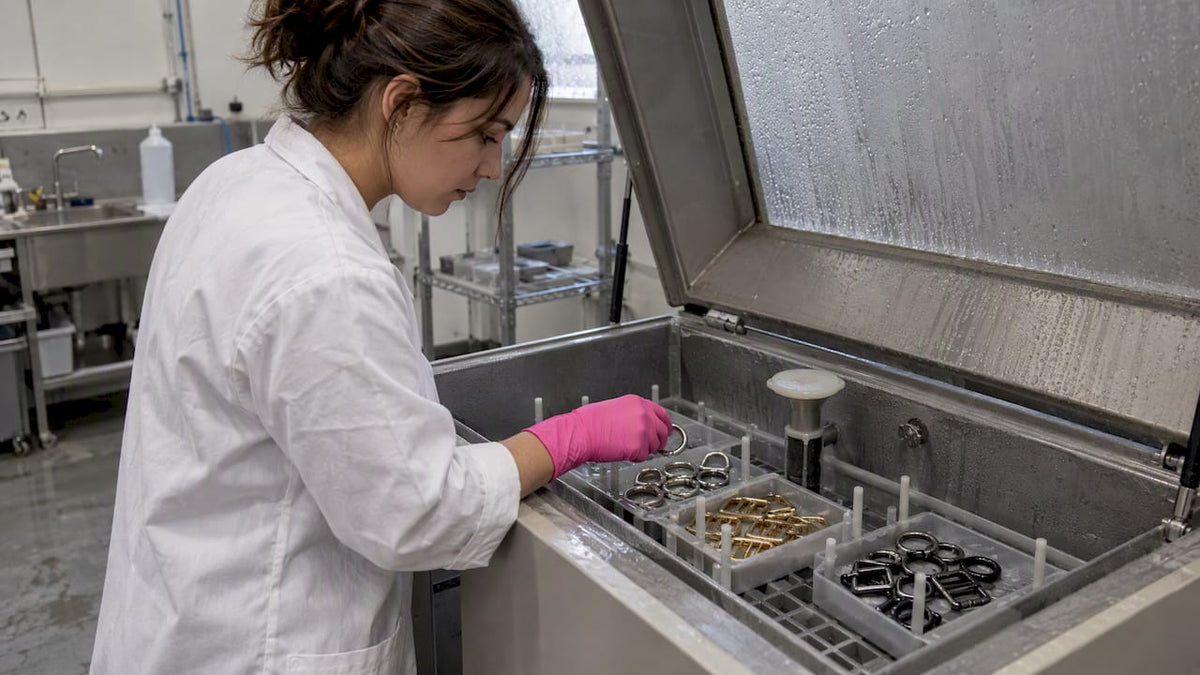
The most rust-resistant hardware choices are 316 stainless steel, well-plated brass, and, for decorative trims only, zinc alloy with a thick protective coating; avoid uncoated zinc alloy entirely. The single most effective habit against bikini hardware rust is rinsing with fresh water right after swimming, since coatings fail and designers should always ask suppliers for salt-spray results before committing to a run.
TL;DR:
- Rinsing with fresh water immediately after swimming in salt or chlorine helps prevent corrosion, especially for coated zinc alloy and plated brass.
- 316 stainless steel offers the best resistance to pitting and crevice corrosion in chloride-heavy environments, outperforming 304 stainless steel.
- Salt-spray testing for 48 hours or more without visible corrosion is the industry standard for deeming hardware suitable for regular water exposure.
- Suppliers should provide detailed documentation on plating thickness, salt spray hours, and lab results, with sample testing recommended before bulk orders.
- Hardware failure is more often caused by neglect and poor design choices than by metal quality alone, emphasizing proper care and thoughtful assembly.
Table of Contents
- Best metals for bikini hardware: stainless steel, brass, and zinc alloy
- How to judge coatings, plating, and finish claims on hardware
- Salt-spray testing and lead rules designers need to request
- Care habits and design choices that cut rust risk
- How to vet suppliers before you commit to a production run
- Our care guides for keeping metallic swimwear hardware lasting longer
- A designer’s take: hardware, fabric, and care are one decision
- Shop swimwear built with care-forward details in mind
- FAQ
- Sources
Best metals for bikini hardware: stainless steel, brass, and zinc alloy
Stainless steel is the standard choice for hardware that meets salt water or chlorine regularly. Industry guidance names stainless steel, plated brass, and coated zinc alloy as the three most reliable material options for swimwear hardware. Between stainless grades, 316 outperforms 304 because it contains molybdenum, which resists pitting and crevice corrosion better in chloride-heavy environments. That said, even 304 stainless is not immune: research on chlorine-induced stress corrosion cracking found that chloride salts promote dissolution-based cracking in 304 stainless under stress, meaning “stainless” is a spectrum, not a guarantee.
Brass performs well when the plating is intact, but raw brass tarnishes and corrodes quickly once exposed to salt or sweat. The base metal and plating need to be compatible, since a mismatch can accelerate galvanic corrosion at the seam where plating wears thin.
Zinc alloy shows up constantly in decorative trims because it is inexpensive and easy to cast into detailed shapes, but it needs a thick, well-bonded coating to survive more than a season of regular wear.
- Stainless steel (316): best for clasps, sliders, and rings on performance or frequent-swim pieces.
- Plated brass: suited to luxury trims and buckles where appearance matters as much as function.
- Coated zinc alloy: fine for decorative charms or embellishments with minimal water contact.
How to judge coatings, plating, and finish claims on hardware
A coating is only as good as its thickness, bond, and base metal, and the gap between a premium finish and a weak one is rarely visible on a hanger. Common finishes include electroplated nickel or chrome, physical vapor deposition (PVD), clear lacquer, and nylon dip coatings, each offering a different balance of durability and cost.
Thin plating wears through fast at friction points like clasp hinges or ring loops, exposing the base metal underneath to moisture. Terms like “gold-tone” describe color only; they say nothing about corrosion resistance, and the same label can sit on a cheap zinc piece or a well-built brass one.
- Electroplated nickel or chrome: moderate protection, thickness-dependent, wears at contact points.
- PVD coatings: thinner but denser, generally more durable than standard plating.
- Clear lacquer: protects against tarnish but scratches off with abrasion.
- Nylon dip coating: good barrier against moisture, common on budget decorative hardware.
When sourcing, request plating thickness in microns, an adhesion test result, and the clearcoat type used. For pieces with daily saltwater exposure, PVD or solid stainless generally outperforms plated brass over time.
Pro Tip: Ask suppliers for a cross-section photo or micrograph of the plating layer, not just a finish name, since the name alone tells you almost nothing about how long it will last.
Salt-spray testing and lead rules designers need to request
Suppliers should hand over real test data, not marketing copy. ASTM B117 salt-spray testing is the accelerated corrosion test the industry relies on, and premium hardware is often tested to withstand many hours without visible corrosion.
48+ hours of salt-spray exposure without visible corrosion is a widely used benchmark for premium swimwear hardware, per industry testing guidance. That figure gives you something concrete to compare across suppliers instead of relying on a generic “corrosion resistant” claim.
For children’s swimwear, CPSIA lead-content rules apply to metallic trims and surface coatings separately from the textile itself, so a supplier’s fabric compliance paperwork does not cover the hardware. A legitimate test report names the lab, cites the test standard, and references a specific sample ID tied to your order, not a generic catalog sheet.

Care habits and design choices that cut rust risk
Hardware fails faster from neglect than from bad metal choices, and the fix usually costs nothing.
- Rinse hardware with fresh water within 30 to 60 seconds of leaving the pool or ocean, since salt and chlorine residue left to dry can crystallize and continue corroding metal even in storage.
- Pat dry with a towel and let pieces air out fully before folding or bagging them, since trapped moisture is what turns a surface scratch into a corroded joint.
- Store finished pieces flat or hung, never crushed in a damp bag, and check care labels before machine washing anything with metal trim.
Design choices matter just as much as care. Exposed solder joints, sharp burrs, and strap widths that concentrate stress at the hardware attachment point all create entry points for corrosion to start, regardless of how good the base metal is.
How to vet suppliers before you commit to a production run
A short checklist during sourcing saves a lot of rework later. Ask every supplier for material grade, plating type and thickness, salt-spray hours, lead test results, their QA process, and a physical sample before you place a bulk order.
- Request documented test reports with lab name, standard used, and sample ID rather than a general product page claim.
- Watch for red flags: no test data on request, vague answers about plating thickness, or samples that look finished differently from batch to batch.
- Run a simple in-house check with a saltwater soak and dry cycle on a sample piece, then inspect it for pitting, discoloration, or coating lift.
Treat the hardware and strap assembly as a single test unit, not isolated parts, since a perfectly rated clasp can still fail early if it is soldered or sized poorly. For larger orders, require third-party lab testing before scaling production rather than trusting a supplier’s internal results alone.
Pro Tip: Keep a saltwater soak sample from every new supplier batch; comparing them side by side over a few weeks tells you more than any spec sheet.

Our care guides for keeping metallic swimwear hardware lasting longer
We recommend practical, step-by-step care content to help maintain swimwear. Our guide to maintaining metallic finishes explains habits that help keep clasps, rings, and charms from dulling or corroding early, and a broader bikini care guide addresses fabric and trim maintenance. Additionally, we suggest a step-by-step washing guide for those unsure how often to rinse, wash, or air-dry a new piece.
A designer’s take: hardware, fabric, and care are one decision
Hardware choice can’t be evaluated alone. A great clasp sewn onto a strap with a sharp edge or soldered joint will still fail early, so we test pieces as finished assemblies, not standalone parts. Before scaling any run, request sample test results and run your own soak cycle.
— Ryan
Shop swimwear built with care-forward details in mind
There is a wide range of trendy, premium swimwear styles available, including athletic bikinis that prioritize performance and durable finishes, and the bikini sets collection includes product notes and care guidance alongside each style.
If hardware durability is a priority, look for styles with fewer exposed metal trims or documented finishes, and check our shop page for current arrivals and sales.
FAQ
What is the best material for bikini hardware?
316 stainless steel is generally the most reliable choice for frequent saltwater or chlorine exposure, since it resists pitting better than 304 stainless. Well-plated brass and thickly coated zinc alloy work for lower-exposure decorative trims, but raw or thinly plated metals corrode fast.
How do I remove rust from bikini hardware?
A soft cloth with a mild vinegar-water solution can lift light surface rust from stainless hardware, followed by a full rinse and dry. Heavily corroded or pitted hardware generally cannot be restored and should be replaced before it stains fabric or breaks.
How often should I rinse bikini hardware to prevent rust?
Rinse with fresh water immediately after every swim in salt water or chlorine, ideally within 30 to 60 seconds, since dried salt residue can crystallize and keep corroding metal in storage. Our bikini care guide covers the full rinse-and-dry routine.
Is zinc alloy hardware bad for swimwear?
Zinc alloy isn’t inherently bad, but it needs a thick, well-bonded protective coating to hold up against water exposure. Uncoated or thinly coated zinc alloy corrodes faster than stainless steel or plated brass and suits decorative pieces more than daily-wear clasps.
What should I ask a supplier before ordering bikini hardware?
Ask for material grade, plating type and thickness, salt-spray test hours, and lead test results with lab name and sample ID attached. Suppliers unwilling to share documented test reports, as opposed to marketing claims, are a red flag before committing to a production run.
Sources
- 16 CFR § 1500.91 — Determinations regarding lead content for certain materials or products (CPSIA guidance)
- Mechanism of chlorine-induced stress corrosion cracking of two 304 SS heats in simulated marine environment