
High-waisted bottoms, ruched one-piece suits, and swimdresses or tankinis cover stretch marks better than any other swimwear category, because they combine rise, ruching, and fabric weight in the exact zones where marks tend to show. The fastest way to shop is to filter for coverage first, then look for ruching or textured fabric, and confirm fit using a reliable size chart. Get those three right and the marks stop being a factor in what you wear to the beach.
TL;DR:
- High-waisted bottoms and ruched one-piece suits reliably cover stretch marks by combining rise, fabric stability, and strategic design features.
- Ruching and textured fabrics scatter light and hide skin imperfections more effectively than flat, smooth fabrics.
- Proper fit, measured with accurate sizing, adjustable elements, and stretch recovery, significantly improves coverage retention during movement.
- Fabrics with LYCRA Xtra Life or similar chlorine-resistant fibers maintain shape and opacity longer in pools, while darker colors and busy prints visually mask marks.
- Cover-ups like sarongs, swim skirts, and rash guards extend coverage off the water, depending on activity and desired level of concealment.
Table of Contents
- What Swimsuit Styles Give the Most Coverage for Stretch Marks?
- What Design Details Actually Hide Stretch Marks?
- How Do You Find the Right Fit for Coverage That Stays Put?
- Which Fabrics and Construction Details Hold Up Best?
- How Can Cover-Ups Extend Your Coverage Off the Water?
- What Should You Check Before You Buy?
- How Doll House Bikinis Approaches Coverage-First Design
- Shopping for a Changing Body: Postpartum and Fluctuating Sizes
- A Design-Minded Take on Confidence and Coverage
- Ready to Shop Coverage-First Swimwear?
- Sources
- FAQ
What Swimsuit Styles Give the Most Coverage for Stretch Marks?
Coverage comes down to two things: how much fabric sits over the area, and how well that fabric holds its position when you move, sit, or swim. A suit that rides up after ten minutes in a lounge chair isn’t doing its job, no matter how much fabric it started with.
High-waisted bikini bottoms are the most requested style for a reason. A high-rise waistband that sits above the hip bone stays anchored during activity far more reliably than a low-rise cut, which tends to slide down as soon as you sit, bend, or swim a lap. That matters because most stretch marks concentrate on the lower abdomen, hips, and upper thighs, exactly the zone a high-rise waistband is built to cover. The Lily Bikini Bottom is a clear example of this category done well: a high-rise, adjustable-front tie bottom built with medium compression fabric specifically to cover lower-tummy scars while still sculpting the waist. That combination, rise plus compression plus an adjustable front, is worth studying even if you’re shopping elsewhere, because it shows what “full coverage” actually looks like on a spec sheet.
Ruched and shirred one-piece suits work through a different mechanism. Ruching bunches the fabric into folds, which breaks up the surface and scatters light across the skin instead of letting it sit flat. Flat fabric shows every ridge and discoloration; folded fabric doesn’t. This is why a ruched maternity swimsuit or a ribbed tie-knot ruched style reads as intentionally designed rather than simply “modest.” Parenting-focused reviewers have pointed to exactly this kind of construction, one-piece suits with built-in tummy control and ruching, as a genuine confidence booster for postpartum bodies, not just a coverage compromise.
Swimdresses and tankinis solve a slightly different problem: they add length and a loose drape over the stomach and upper thigh without feeling like a wetsuit. A swimdress skirt moves with you, so it covers when you’re standing at the snack bar and doesn’t restrict you when you’re wading in. Tankinis do something similar from the top down, extending torso coverage while keeping the separate-piece flexibility of a bikini.
Full-coverage bottoms, board-style shorts, and higher-rise briefs round out the category for anyone who wants zero exposure below the waist. A higher-rise brief, cut to sit at or above the navel, covers more of the lower abdomen and hip than a standard bikini bottom without the compression feel of shapewear. Board-style shorts go further still, extending coverage down the thigh, which works well for anyone with marks on the upper leg as well as the stomach.
Here’s how the main silhouettes stack up against different beach and pool scenarios:
- Lap swimming or active water play: a one-piece with ruching and a higher leg cut moves with you and won’t shift during strokes or dives.
- Lounging poolside or on sand: a swimdress or tankini gives coverage while sitting, walking, or reaching for a drink without cinching anywhere.
- Family beach days with kids in and out of the water: high-waisted bottoms with a supportive top let you move fast without constant readjustment.
- Postpartum or recovering bodies: a ruched one-piece with built-in tummy support covers scars and marks while avoiding tight compression on sensitive skin.
- Warm-weather lounging with minimal swimming: a swim skirt or higher-rise brief paired with a soft, unlined top keeps things breathable.
None of these silhouettes are mutually exclusive. A lot of women end up owning two: one built for movement and one built for lounging. If you’re only buying one suit this season, a ruched one-piece with a mid-to-high leg cut covers the widest range of situations.
What Design Details Actually Hide Stretch Marks?
Swimwear designers work with two different toolkits for concealment, and knowing the difference changes how you shop. One relies on visual tricks. The other relies on physical compression. Neither is objectively “better,” but they solve different problems.
Passive masking uses pattern, texture, and fabric movement to distract the eye rather than flatten the skin underneath. Busy prints, metallic or textured weaves, and ruching all fall into this category. A patterned fabric breaks up the eye’s ability to track a continuous line across the skin, which is exactly what a stretch mark is: a line. Ruching does the same thing physically, folding the fabric so no single section lies flat long enough to show detail. Passive masking tends to be the more comfortable option for all-day wear, since it doesn’t rely on tight elastic to do the work.
Active smoothing relies on firmer, higher-denier fabric panels sewn into key zones, usually the stomach and lower back, to compress and flatten the skin’s surface. This is the approach behind suits like the Lands’ End SlenderSuit, which uses LYCRA Xtra Life fabric and structured shirring to create tummy control without losing stretch. Compression works, but it comes with a tradeoff: firmer panels run warmer, feel tighter by the end of a long beach day, and can dig if the size runs small. If you’re planning to spend six hours in the sun, that’s worth weighing against a few hours of pool time.
Design details can do double duty, functioning as both structure and style so the coverage doesn’t read as an afterthought. Adjustable side ties, decorative knots at the hip, and ruffled trim all add fabric exactly where you want it while looking like a deliberate style choice rather than a cover-up. A ribbed tie-knot swimsuit or a ruffled high-waisted style puts this into practice: the tie and the ruffle aren’t decorations bolted onto a plain suit, they’re the coverage mechanism itself.
Which feature to prioritize depends on where your marks sit:
- Lower abdomen and C-section area: high-rise waistband plus ruching or a front tie for adjustability.
- Hips and upper thighs: a fuller-cut bottom or attached skirt rather than a narrow-cut brief.
- Chest and underarm area: a textured or patterned top with wider straps and more fabric coverage than a triangle cut.
- Lower back: a one-piece with a higher back panel instead of a low-scoop design.
Pro Tip: If you’re torn between a heavily compressive suit and a ruched one, buy the ruched style first. Compression suits are much easier to size correctly once you already know how your body responds to a snug fit, but a ruched suit is more forgiving on a first try and rarely feels disappointing once it’s on.
How Do You Find the Right Fit for Coverage That Stays Put?
A coverage-focused suit that doesn’t fit correctly can undo everything the design was supposed to do. Fabric that’s too tight digs in and draws the eye to exactly the spot you’re trying to cover. Fabric that’s too loose shifts and gaps, exposing the area anyway. Getting fit right matters more than picking the “right” style.
- Measure bust, underbust, waist, and hips before you shop, using a soft tape measure and comparing the numbers to the brand’s actual size chart rather than guessing from your usual clothing size. Swimwear sizing runs differently from everyday apparel, and a size that fits your jeans can run tight or loose in a swim fabric blend.
- Check the fabric content and stretch recovery, not just the coverage claim on the product photo. A blend with strong recovery, meaning it bounces back to its original shape after stretching, holds coverage through a full day of sitting, swimming, and standing. A blend with weak recovery loosens by the second wear and stops covering the way it did out of the box.
- Use adjustable elements to fine-tune fit rather than buying the size that’s “close enough.” Side ties, adjustable straps, and wrap waistbands let you dial in coverage at the exact spot where a fixed-size suit would either dig or gap.
- Decide between sizing up or relying on compression based on how you actually want to feel by the end of the day. Sizing up in a soft, flexible fabric gives more breathing room and less digging, but slightly less flatness. Staying true to size in a compression fabric gives more shaping but runs tighter for hours at a stretch. Neither choice is wrong, but they feel very different by hour four.
- Try the suit on and move, not just stand still. Sit down, raise your arms, take a few steps. A suit that only looks right standing perfectly still isn’t ready for a beach day.
- Check the return policy before you buy, especially for online orders where sizing is a guess until the box arrives. A brand that makes returns easy and publishes a detailed sizing guide is telling you it expects most customers to get the size right the first time.
Fit matters more than the number on the tag. A suit one size up in a high-recovery fabric with adjustable ties will almost always outperform a “correct size” suit in a stiff, low-recovery blend, because comfort and coverage both depend on the fabric holding its shape against your specific body, not against an average body the pattern was cut for.
Which Fabrics and Construction Details Hold Up Best?
Fabric choice decides whether a suit still covers what it’s supposed to cover after ten wears in a chlorinated pool, or whether it’s stretched out and see-through by midsummer.
Nylon and spandex blends built with LYCRA Xtra Life fiber resist the two biggest threats to swimwear: chlorine and UV exposure. Standard spandex breaks down fast under repeated chlorine contact, losing recovery and turning thin at the exact stress points, hips, stomach, seat, where coverage matters most. LYCRA Xtra Life is engineered specifically to resist that breakdown, which is part of why it shows up in structured, coverage-driven suits like the SlenderSuit line built around chlorine-resistant tummy control fabric.
Compression fabric and flexible stretch fabric serve different jobs inside the same suit. Compression panels, usually placed at the stomach or lower back, are heavier and less stretchy by design, which is what creates the smoothing effect. Flexible stretch fabric elsewhere in the suit, at the leg openings and straps, keeps the whole piece from feeling restrictive. A well-built suit blends both rather than using one fabric throughout. Lining matters here too: a fully lined suit holds its shape and opacity far longer than an unlined one, and it won’t go sheer when wet, which is a real risk with lightweight prints.
Color and pattern choices genuinely change how visible a mark looks, separate from the physical coverage. Darker solids, navy, black, deep jewel tones, absorb light rather than reflecting it, which reduces the contrast that makes a stretch mark stand out. Busy prints do a version of the same thing by giving the eye multiple points to focus on instead of one continuous line.
- Choose LYCRA Xtra Life or similarly branded chlorine-resistant blends for suits worn frequently in pools.
- Choose lined fabric over unlined for anything you’ll wear wet for hours.
- Choose darker solids or busy prints over pale solids if visual de-emphasis matters to you.
- Rinse in cool fresh water after every wear, chlorine and salt both accelerate fiber breakdown.
- Skip the washing machine and dryer entirely; hand wash and lay flat to dry.
- Avoid leaving a wet suit balled up in a bag, damp fabric against damp fabric speeds up elastic fatigue.
How Can Cover-Ups Extend Your Coverage Off the Water?
The suit does most of the work, but what you wear over it decides how comfortable you feel walking from the towel to the snack stand. A sarong wraps and ties at the hip, giving instant coverage over the stomach and thighs without adding bulk, and it works well for anyone who wants to keep the option to unwrap for a swim. A swim skirt attaches at the waistband or layers over a bottom, giving permanent thigh coverage that stays on through the water instead of coming off at the shoreline. A rash guard, originally built for sun protection, doubles as a lightweight top layer that covers the stomach and arms for anyone who wants coverage during active play rather than lounging.
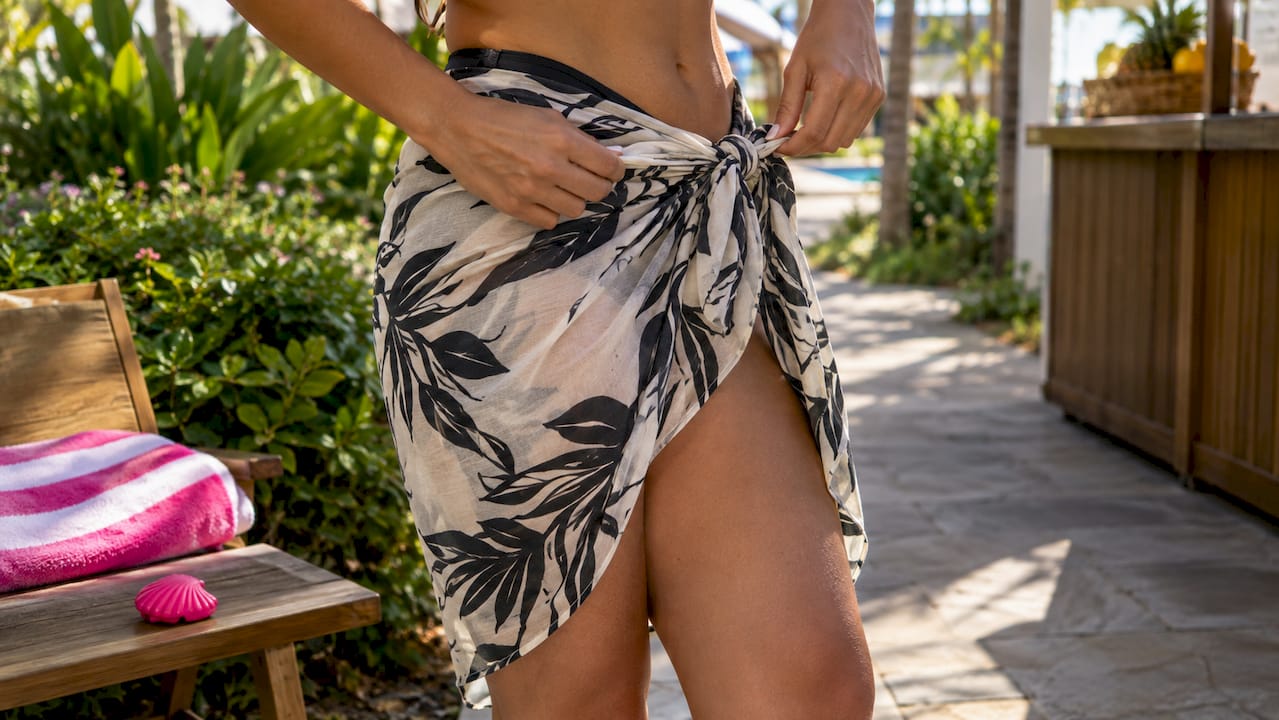
Pairing pattern and color across the suit and cover-up creates a cohesive look rather than two mismatched pieces fighting for attention. A patterned suit under a solid, darker cover-up reads as styled. A solid suit under a patterned wrap does the same in reverse. Either combination works better than a busy suit under a busy cover-up, which can look cluttered rather than intentional.
Accessories close the gap between “covered” and “put together.” High-waisted shorts over a bikini bottom, a lightweight wrap knotted at the hip, or a two-piece set with a built-in jumpsuit coverup all extend coverage while looking like a deliberate outfit choice rather than an add-on.
- Sarong: best for lounging, quick to remove for a swim.
- Swim skirt: best for active days with lots of in-and-out water time.
- Rash guard: best for sun protection during long outdoor stretches.
- High-waisted shorts or a wrap: best for adding a finished, styled look over any suit.
For a pool party or beach day where you’re mostly sitting, a sarong or wrap gets more use than a rash guard. For a day spent actually swimming, skip the wrap and lean on the swimsuit’s own coverage instead, wet fabric wraps get heavy and cling in ways that stop looking intentional fast.
What Should You Check Before You Buy?
A few minutes on the product page can save an entire return-and-reorder cycle. Run through this before checkout:
- Confirm the rise. Product descriptions should state whether a bottom is high-rise, mid-rise, or low-rise; if that word is missing entirely, treat it as a red flag.
- Check back coverage separately from front coverage. Some “full coverage” bottoms cover the front well but cut narrow at the back, which matters if your marks extend to the hips or lower back.
- Read the fabric content line. Look for a named stretch fiber, such as LYCRA Xtra Life, rather than a vague “premium fabric” claim with no specifics.
- Confirm whether the suit is lined. An unlined suit in a light color can go sheer when wet, which defeats the purpose of buying for coverage in the first place.
- Check model measurements against the size worn in photos. A product photo means little without knowing the model’s actual measurements and the size she’s wearing.
- Read the return policy before adding to cart, not after the suit arrives and doesn’t fit.
- Note the wash instructions. A suit that requires hand washing and flat drying will hold its shape far longer than one that claims to survive a washing machine.
Red flags worth walking away from: no printed size guide, a fabric description that only says “stretchy” with no fiber content, and a no-returns policy on swimwear, which is common but should be disclosed clearly before you pay, not buried in a footer link.
Pro Tip: Before you buy, hold the fabric up to a bright light in the store or check close-up photos online. If light passes through easily, the suit will likely go see-through when wet, no matter how flattering the cut looks dry.
If you’re shopping from home, do a rough at-home fit test with a suit you already own in a similar rise: measure where the waistband would sit and compare it to the new suit’s listed rise measurement. It’s not perfect, but it catches the worst mismatches before they become a return.
How Doll House Bikinis Approaches Coverage-First Design
Doll House Bikinis built several of its collections specifically around the coverage priorities this guide has walked through: high rise, ruching, and adjustable fit. The maternity and postpartum-friendly line leans on ruched paneling and tie details rather than stiff compression, which aligns with the passive-masking approach many women find more comfortable for all-day wear. A scalloped cut-out ruched maternity swimsuit and a ribbed tie-knot ruched maternity swimsuit both put that construction into practice: ruching across the stomach, an adjustable tie for a custom fit, and design lines placed specifically over the areas most postpartum shoppers ask about.
The high-waisted category follows the same logic from the bottom up. A ruffle ribbed high-waisted maternity swimsuit sits above the hip the way this guide recommends, with a ruffled edge that turns the coverage line into a design feature instead of hiding it.
Author Ryan brings a swimwear design background to this guide, which shows up in the specificity of the fit advice: the emphasis on rise placement, fabric recovery, and adjustable ties over vague “flattering” language reflects an understanding of how these garments are actually constructed, not just how they photograph.
A few practical ways to put this into action on the site:
- Use the category filters for high-waisted and one-piece styles to narrow results before scrolling through everything.
- Look at the ruched maternity swimsuit styles first if you’re shopping postpartum, since they’re built around that exact use case.
- Read the product description for fabric content and rise before adding anything to the cart, the same checklist covered above.
Shopping for a Changing Body: Postpartum and Fluctuating Sizes
Bodies change fast after pregnancy, after weight loss, or after any major shift, and swimwear sizing rarely keeps pace with how quickly that happens. The most useful approach isn’t chasing a “before” size. It’s re-measuring now, at the size your body actually is, and shopping from that number instead of a memory.
Postpartum bodies in particular tend to carry extra softness or sensitivity around the stomach and hips for months, sometimes longer, which is exactly why ruched, high-rise, one-piece styles with soft interior linings tend to outperform stiff compression suits during this window. Reviewers describing their postpartum swimsuit experience consistently point to bust support and gentle tummy control, not aggressive shaping, as what actually got worn all summer.
If your weight fluctuates seasonally or your size shifts month to month, prioritize suits with adjustable ties, wrap closures, or stretch waistbands over fixed-structure suits. A postpartum-focused swimsuit collection built around this kind of flexibility saves you from rebuying every time your size shifts by a few pounds in either direction. When in doubt between two sizes, size up in a flexible fabric rather than down in a compression fabric. A slightly loose suit in soft fabric is comfortable; a slightly tight suit in stiff fabric is not.
A Design-Minded Take on Confidence and Coverage
Marks on your skin are not a flaw to engineer around, they’re just a detail a good swimsuit accounts for, the same way a designer accounts for a bust size or a torso length. The suits that actually get worn all summer are the ones built with intention: a ruched panel placed exactly where it needs to be, a waistband cut to sit above the hip instead of sliding down it, a tie that lets you adjust fit instead of guessing at a fixed size.
The biggest mistake in this category isn’t picking the “wrong” style, it’s over-prioritizing compression when comfort would have served better. A suit that digs by hour two gets left in the drawer, no matter how smoothing it looked in the dressing room mirror. Comfort you’ll actually wear beats shaping you’ll avoid.
If you’re unsure where to start, check the sizing guide before you fall in love with a specific print, and read the return policy before you buy. Getting those two things right solves more fit problems than any single design feature ever will.
— Ryan
Ready to Shop Coverage-First Swimwear?
Doll House Bikinis built its maternity and high-waisted lines around exactly the coverage priorities this guide walks through, so you’re not translating generic advice into a random product search. Browse the one-piece swimsuit collection for ruched and structured styles, check the bikini bottoms category for high-rise cuts, and pair either with a supportive top for full coverage top to bottom.
New shoppers can often find discounts and free shipping offers, making it more affordable to build out a full coverage-first look, combining a suit plus a cover-up like the two-piece jumpsuit coverup. Check the sizing guide against your own measurements first, then add your top pick to the cart. If the fit isn’t right, the return process is there so a bad size doesn’t become a wasted purchase.
Sources
- Lily Bikini Bottom | High-Rise Swimwear for Survivors | POST SWIM
- Lands’ End women’s SlenderSuit - Target product page
- The £25 swimsuit I lived in postpartum has bust support and clever tummy control - Netmums
FAQ
Does a High-Waisted Bikini Really Hide Stretch Marks Better?
Yes, because a high-rise waistband sits above the hip and stays anchored during movement, unlike low-rise cuts that slide down and expose the lower abdomen. It covers the exact zone, lower belly and upper hip, where most stretch marks concentrate.
How Did Celebrities Reportedly Address Stretch Marks Before Swimwear Shopping?
Public accounts of celebrities like Kim Kardashian addressing stretch marks generally mention topical treatments and in-office procedures rather than a single fix, and results vary widely by individual skin and mark age. Swimwear with ruching, high-rise coverage, or a compression panel offers a far more immediate and affordable way to feel confident at the beach than waiting on any treatment outcome.
Is There a Best Swimsuit Fabric for Concealing Marks?
A nylon-spandex blend with a fiber like LYCRA Xtra Life holds its shape and opacity longer than basic spandex, especially in chlorinated pools, and lined fabric prevents the sheerness that exposes skin when wet. Darker solids and busy prints also reduce visual contrast, making marks less noticeable even before the fabric’s construction comes into play.
Is It Too Late to Address Older Stretch Marks Before a Beach Trip?
No single timeline makes stretch marks harder to address with swimwear, since coverage-focused design works regardless of how old or faded the marks are. A ruched one-piece or high-waisted bottom conceals marks from any point in time just as effectively as it would a fresh one.
What Should I Look for in a Plus-Size Swimsuit With Coverage?
Look for a high-rise or full-coverage bottom, a lined fabric with genuine stretch recovery, and a published size chart with model measurements rather than a vague size range. A brand’s sizing guide is the fastest way to check all three before ordering.