
The best maternity swimsuit is a ruched one-piece or an adjustable tankini with real bust support, not a regular suit stretched a size too big. Prioritize three things: a shelf bra or wide underband for support, side ruching for growth room, and adjustable straps that move with you. Shop for your anticipated later pregnancy size, and choose styles with easy on/off features if you’re buying for the later stages of pregnancy.
TL;DR:
- Supportive maternity swimsuits must have a shelf or molded cup bra with a wide underband for optimal lift.
- Ruching along the sides or front is essential for accommodating belly growth without bagging out early.
- For late pregnancy, choose suits with easy on/off features like zippers or drop seats to facilitate bathroom trips.
- Buy for your anticipated maximum size, especially in the third trimester, to ensure the suit lasts through all stages.
- High elastane content (15-20%) in fabric is crucial for maintaining shape and stretch during pregnancy.
Table of Contents
- Maternity Swimsuits Guide: The Features That Actually Matter
- One-Piece, Tankini, Bikini, or Rashguard: Which Style Fits Your Pregnancy?
- What to Buy in Each Trimester (and When)
- How to Measure and Size a Maternity Swimsuit Correctly
- Fabric, Stretch, and Sun Protection: What the Label Should Say
- Practical Details That Make Daily Wear Easier
- Smart Shopping: Budget, Timing, and Return Policies
- How Doll House Bikinis’ Maternity Styles Match This Checklist
- The Real Priority Order for Maternity Swimwear
- Find Maternity Swimwear Built for Support, Not Just Trend
- Sources
- FAQ
Maternity Swimsuits Guide: The Features That Actually Matter
A maternity swimsuit lives or dies on five details, and most shoppers only check one of them before buying.
Bust support changes the most across pregnancy. A basic shelf bra (a thin built-in liner) works fine early on, but by the second trimester many women need molded cups or underwire for real lift. Wide underbands distribute weight better than thin elastic, which matters once bust size increases and stays increased through nursing.
Ruching is the single most useful design feature in maternity swimwear. Technically, it works as a negative dart: gathered fabric along the sides or front that expands with a growing belly while keeping the suit fitted instead of baggy in earlier months. That’s why a well-ruched suit purchased in month four can still look intentional, not oversized, in month eight, according to Forbes’ maternity swimwear guide.
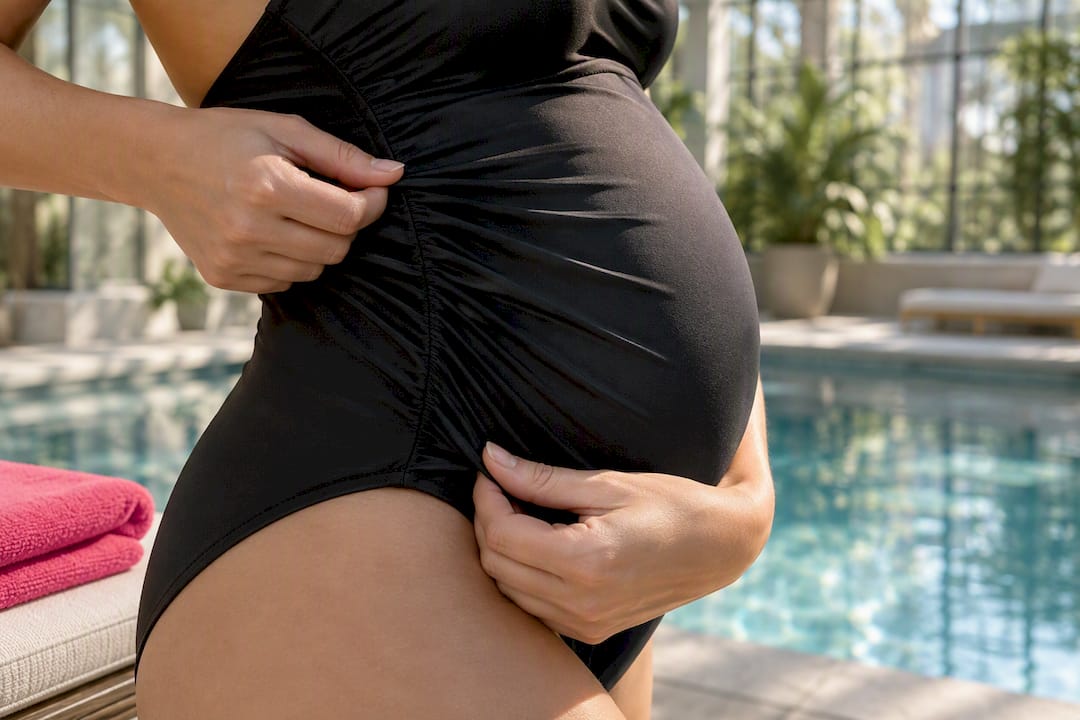
Waistbands and leg cuts decide whether a suit feels good after two hours poolside or starts digging in after twenty minutes. Soft, wide bands and generous leg openings reduce chafing and rolling, which becomes more noticeable as the belly pushes down on the waistline.
Ease of on/off deserves more attention than most buyers give it. Front zips, drop seats, and tie-side bottoms all make bathroom trips faster, a real concern by the third trimester when bathroom trips multiply.
Fabric durability comes down to stretch and recovery, covered in more detail below, but check it on every product page alongside the size chart and customer reviews before buying.
- Shelf bra or molded cup with wide underband for support
- Ruched side panels or front paneling for growth room
- Soft, wide waistband and roomy leg cuts to prevent chafing
- Front zip, drop seat, or tie-side closures for faster changes
- High elastane content (check the fabric listing) for stretch that holds its shape
Pro Tip: Read the fabric content line on the product page before the size chart. A suit with the right stretch percentage will forgive an imperfect size choice; a suit with poor recovery won’t, no matter how well you measured.
One-Piece, Tankini, Bikini, or Rashguard: Which Style Fits Your Pregnancy?
Choosing a silhouette is really about choosing a trade-off between support, convenience, and personal style.
The one-piece gives the most unified support and is the strongest choice for active swimming. Side-tie and drop-seat versions solve the biggest complaint about maternity one-pieces (the bathroom problem) without sacrificing the support that makes one-pieces the safer pick for lap swimming or water aerobics.
The tankini solves a different problem: bust and belly sizes rarely grow at the same rate, and a two-piece top-and-bottom combination lets you size each independently. This flexibility makes tankinis a practical middle ground for women whose measurements shift unevenly month to month.
Bikinis with high-waisted bottoms trade some coverage for visibility and versatility. A supportive top matters more here than in any other style, since there’s no unifying structure to fall back on. High-waist bottoms also tend to have the longest life span in a wardrobe, since they work through pregnancy and slide easily into postpartum wear.
Rashguards matter for anyone doing more than lounging poolside. They add sun coverage over the shoulders and upper arms, areas standard suits leave exposed, and pair well underneath a bikini top for water sports or long beach days.
- One-piece: best for lap swimming, water aerobics, maximum support
- Tankini: best for mismatched bust/belly growth, easy mix-and-match sizing
- High-waist bikini: best for visibility, postpartum crossover use
- Rashguard: best for sun coverage during active water time
Stylist guidance backs this up directly: pick the suit that matches how you want to feel, not one designed to hide the bump, since Forbes notes adjustable features and ruching can deliver both style and fit at once.
What to Buy in Each Trimester (and When)
Timing your purchase around your due date, not the calendar month you’re shopping in, saves both money and closet space.
- First trimester. Most pre-pregnancy swimsuits still fit, aside from added bust support needs. If you’re only swimming occasionally this early, skip the maternity purchase and wait.
- Second trimester (weeks 13 to 26). This is when dedicated maternity swimwear becomes genuinely useful, according to BabyCenter’s pregnancy timeline. Ruching and adjustable straps start doing real work here, accommodating the growth curve that accelerates through these weeks.
- Third trimester (weeks 27 to 40). Priorities shift again: maximum bust support, generous belly coverage, and fast on/off features move to the top of the list. Comfort during water exercise also matters more now, and the American College of Obstetricians and Gynecologists continues to recommend staying active through late pregnancy when appropriate, which makes a well-fitting suit for swimming a genuinely useful investment, not just a vacation purchase.
If you plan to swim through the later months, buy for your anticipated third-trimester size, not your current one. A ruched, adjustable suit purchased in month five with room to grow will outlast three separate suits bought progressively larger as the months pass. That’s the core money-saving logic behind maternity-specific design: one well-chosen suit covers a much wider window than a standard swimsuit ever could.
How to Measure and Size a Maternity Swimsuit Correctly
Getting the size right starts with three measurements, taken over your bare skin or thin underwear, not over clothing.
Measure your bust at the fullest point, keeping the tape level around your back. Measure your underbust directly beneath your bust line, where a support band would sit. Measure your hips at the widest point, usually a few inches below the belly button once you’re further along. Write these down and check them again every few weeks, since pregnancy measurements shift faster than most people expect.
The general rule: size up for your bust first. If your bust measurement lands between two sizes, take the larger one. A suit with strong ruching and adjustable straps will let you stay in that size longer than a rigid, non-adjustable suit would, since the ruched panels expand with you instead of forcing an early size change.
- Measure bust, underbust, and hips before ordering, not after
- When between sizes, size up for the bust, not the belly
- Read customer review photos to see how a suit fits at different pregnancy stages
- Check the stretch and recovery claims on the product page. Suits with better recovery hold their shape longer, which matters if you’re buying early to wear through multiple trimesters
If you’re shopping in person, do a quick range-of-motion check before leaving the fitting room: raise your arms overhead and sit down. A suit that stays in place through both movements will handle a beach day.
Fabric, Stretch, and Sun Protection: What the Label Should Say
Fabric content decides whether a swimsuit still looks new in month eight or has already gone slack and lost its shape.
Look for nylon or polyester blended with roughly 15 to 20% elastane, a ratio commonly recommended by maternity swimwear developers for the kind of four-way stretch and reliable recovery pregnancy swimwear needs. “Stretch and recovery” simply means the fabric expands with movement and belly growth, then returns to its original shape instead of sagging out. Lower elastane blends tend to bag out fast, especially around the belly panel where the fabric works hardest.
Sun protection deserves equal attention. Pregnancy increases the risk of melasma, the patchy skin discoloration triggered largely by UV exposure, and the American Academy of Dermatology notes that UPF-rated clothing is a meaningful addition to sunscreen, not a replacement for it, particularly for skin already sensitized by hormonal changes.
- Look for nylon/polyester with 15 to 20% elastane on the fabric label
- Choose UPF 50+ where available, especially for shoulders and chest
- Rinse suits in cool water after chlorine or salt water exposure
- Air dry away from direct heat to protect elasticity and color
Practical Details That Make Daily Wear Easier
The features that matter most day to day rarely show up in a product photo, but they show up the first time you actually try to use the suit.
Nursing-ready designs extend a suit’s usefulness well past the delivery date. Wrap fronts, pull-aside necklines, and nursing-clip straps let a suit double as postpartum swimwear, which can justify spending a bit more upfront on a piece you’ll wear for a full year or longer rather than a few months.
Closures matter more than they seem to. Side ties and drop seats speed up bathroom trips, a real consideration once bathroom frequency increases in later pregnancy. Seam placement matters too. Flat-lock seams and soft binding around the leg and underarm reduce chafing on skin that’s often more sensitive during pregnancy.
- Wrap-front tops or nursing clips for postpartum use
- Side-tie or drop-seat bottoms for faster bathroom trips
- Flat-lock seams and soft binding to reduce chafing
- Adjustable straps that convert easily from support mode to nursing access
Pro Tip: If you plan to breastfeed and swim in the months after delivery, buy the nursing-friendly version now. Most maternity suits with wrap fronts or pull-aside necklines work identically well as postpartum swimwear, so you’re not buying two suits when one will do the job.
Smart Shopping: Budget, Timing, and Return Policies
Spend where it actually extends the suit’s life, and save where it’s purely decorative.
Structured support, durable fabric blends, and UPF protection are worth paying more for, since they directly affect how long a suit lasts and how comfortable it stays through multiple trimesters. Purely decorative trims, prints, or hardware don’t affect fit or function, so there’s little reason to pay a premium for them alone.
Buy earlier than feels necessary if you know you’ll swim through the third trimester. Suits with strong ruching and adjustable features are designed to accommodate that growth, so an earlier purchase in a slightly larger size often outlasts a “perfect fit” suit bought too late to adjust.
- Check the return policy before buying, especially for online orders without a fitting room
- Read the size chart against your actual measurements, not your pre-pregnancy size
- Look at customer photos, not just the product model, to judge real-world fit
- Save receipts. Sizing needs can change fast enough to require an exchange
How Doll House Bikinis’ Maternity Styles Match This Checklist
Doll House Bikinis carries maternity pieces built around the same features covered throughout this guide, rather than treating maternity swimwear as an afterthought category.
The Ruffle Ribbed High Waisted Maternity Swimsuit pairs a high-waist bottom with ruched detailing, the combination this guide flags as useful for growth accommodation and postpartum crossover wear. The Scalloped Cut Out Ruched Maternity Swimsuit shows ruched side paneling in a one-piece format, illustrating the negative-dart construction that lets a suit expand without looking oversized early on. The Ruch Scallop V Neck One Piece Maternity Swimsuit applies the same ruching principle with adjustable straps for bust support that shifts as needed.
For anyone planning ahead to postpartum wear, the site’s postpartum swimwear guide breaks down which nursing-ready features carry the most value after delivery.
On the site itself, filtering by style, size, and price speeds up comparison shopping, and the sizing guides attached to each product page make it easier to check bust and hip measurements before ordering. Orders over $100 ship free, which matters if you’re buying more than one silhouette to cover different trimesters.
- Ruched panels shown across multiple maternity product listings
- High-waist bottoms available for postpartum crossover use
- Adjustable straps standard on featured maternity one-pieces
- Sizing guides and filters available site-wide for faster comparison
The Real Priority Order for Maternity Swimwear
Most buying advice treats maternity swimwear as a styling problem: how to look good with a changing shape. That’s backward. The actual problem is functional, and the styling mostly takes care of itself once the function is right.
Ruching gets treated as a decorative afterthought in a lot of shopping guides, when it’s actually the single feature doing the most mechanical work. A suit with real ruching and a supportive band will outperform a “flattering cut” every time, because the flattering cut usually depends on a fit that stops working by month six. Bust support is the second most underrated factor. Shoppers fixate on belly coverage, but the bust changes shape and size faster than almost anything else during pregnancy, and a suit that doesn’t account for that will feel wrong long before the belly becomes the issue.
If there’s one thing worth prioritizing above all else, it’s buying for the size you’ll be at your heaviest point of wear, not the size you are the day you order. That single decision prevents more wasted purchases than any styling choice ever will.
— Ryan
Find Maternity Swimwear Built for Support, Not Just Trend
You can shop maternity styles built around the features this guide actually recommends, without wading through generic swimwear that wasn’t designed for a changing shape.
Early in pregnancy, a supportive high-waist bikini or tankini from the bikini sets collection covers the bust-support priority without committing to a full maternity silhouette yet. By the second and third trimesters, dedicated maternity one-pieces with ruching and adjustable straps, like the styles detailed above, take over as the more practical choice. The site’s filters let you narrow by style and price fast, sizing guides sit right on each product page, and orders over $100 ship free, so building out more than one silhouette for different trimesters doesn’t mean paying shipping twice. Browse the full swimwear collection to compare maternity and standard styles side by side, and check the size chart against your current measurements before you check out.
Sources
FAQ
What are the best swimsuits to wear during pregnancy?
A ruched one-piece or an adjustable tankini with a shelf bra or wide underband tends to work best through most of pregnancy. Look for high elastane content for stretch and recovery, and prioritize easy on/off features like side ties or drop seats as you get closer to the third trimester.
What is a pubikini?
A pubikini generally refers to a low-rise or minimal-coverage bikini bottom style, not a maternity-specific term. It isn’t a recommended choice for pregnancy swimwear, since it offers none of the belly support or coverage that maternity-specific designs are built around.
Do I need special swimsuits for maternity?
Not always in the first trimester, when many pre-pregnancy suits still fit with adequate bust support. By the second trimester, dedicated maternity swimwear with ruching and adjustable features becomes genuinely more useful, and by the third trimester it’s the more comfortable option.
What is the best swimwear to wear after giving birth?
Suits with nursing-friendly details like wrap fronts, pull-aside necklines, or nursing clips work well postpartum, since they double as functional nursing access. Many maternity suits, including ruched one-pieces and high-waist bikini bottoms, transition directly into postpartum wear without needing a separate purchase.
How much do maternity swimsuits cost?
Prices vary by style and brand, so it’s worth comparing a few options before deciding what to spend. Current prices for Doll House Bikinis’ maternity styles are listed directly on each product page on the site.